Myth says Trojan prisoners of war built Tenea, and the city stayed buried under farmland near Corinth until 2018, Greek City Times reported. BBC Travel told the story of the search in 2019, when writer Jessica Bateman toured the site with archaeologist Elena Korka and her team. This is how that search went, and what the digs have turned up since.
A city known from legend
According to BBC News in 2018, legend has it that Tenea was founded by Trojans captured by King Agamemnon of Mycenae during his war with Troy in the 12th or 13th century BC. BBC Travel, in 2019, gave the myth a founding date of sometime around 1100BC and said the Trojans chose the spot because it lay on the road between Corinth and the ancient settlement of Mycenae. BBC Travel also noted that, in legend, Oedipus was raised there after being sent away as a baby.
Until 2018, according to the Associated Press, not much was known about Tenea apart from ancient references to its reputed link with Troy and to its citizens having formed the bulk of the Greek colonists who founded Syracuse in Sicily. BBC Travel added that nobody could work out exactly where the city was, or why it disappeared.
A broken coffin in 1984
BBC Travel reported that the search for Tenea began in 1984, when Korka was five years into her career and local villagers digging a water channel hit an ancient sarcophagus. They broke it in half and called her in. Shaped like a vase, the coffin held a skeleton and offerings for the dead, and lions were painted on its inside. "The minute I saw it, I understood it was something unique," Korka said.
Her youth, her inexperience and the lack of further evidence kept her from getting an excavation licence, BBC Travel reported. In 2010 she helped the police and informants stop the illegal sale of two statues looted nearby, and she was finally given permission to dig. Excavation began in 2013.
A false start, then the city
BBC Travel reported that a third party first ran a geophysical survey of the area, but digging turned up nothing: the shapes the survey had picked up were made by the limestone soil. Korka said the team then returned to the spot where the first sarcophagus had been found, and nearby found about 40 others. BBC Travel reported that the team next uncovered part of an ancient road, which led to a Roman mausoleum from around 100BC where several generations of a family were buried, plus a cistern that would have been used for rituals and sacrifices. Knowing this lay outside the city, the team dug north, and in October 2018 houses were discovered and the team realised it had finally found the city itself.
What the ministry announced in 2018
On 13 November 2018, the Associated Press reported that Greece's culture ministry had said archaeologists had located the first tangible remains of the lost city. A ministry statement said excavations from September to early October had turned up "proof of the existence of the ancient city" of Tenea, until then known mostly from ancient texts. Finds included walls and clay, marble or stone floors of buildings, household pottery, a bone gaming die and more than 200 coins dating from the 4th century B.C. to late Roman times.
The AP also reported that a pottery jar holding the remains of two human fetuses was found amid the foundations of one building, which was unusual because the ancient Greeks typically buried their dead in organised cemeteries outside the city walls. BBC News reported that seven graves, including one containing the remains of a woman and child, were unearthed, adorned with vases and jewellery, while the AP, as carried by Voice of America, put the season's burials at nine. Korka told the AP that her team had only been digging in the rich cemeteries surrounding Tenea until that year. "The citizens seem to have been remarkably affluent," she said, adding that the city probably did well out of trade, standing on a key route between the major cities of Corinth and Argos.
Different, say the excavators
Korka tied the finds to the Trojan story. BBC Travel reported that the team's finds so far showed the people of Tenea used different styles of ceramics and had a different burial tradition from those in nearby Corinth and Mycenae, such as placing the coin on the chest rather than in the mouth. "The people here were different – they were Trojans. They had their own identity," Korka said. Elsewhere in the same account she said: "Almost everything in Tenea is unique."
Korka's colleague Konstantinos Lagos showed the BBC Travel writer gold-leaf imitation coins that would have been buried with the deceased as a gift for the boatman in the underworld. "Most people [at the time] were buried with pennies," Lagos said. BBC Travel listed other finds too, among them painted vases, engraved lanterns and metal tools athletes used to scrape oil off their bodies, which in 2019 led the team to believe there was a stadium still to be found.
Why a city of perhaps 100,000 emptied
Sparta, Athens and Corinth are still lived in today, BBC Travel noted, yet Tenea, which it said probably had around 100,000 inhabitants, was abandoned completely, and no historical text explains why. "We know Alaric, who was king of the Visigoths, raided Greece in 397AD," Lagos said, adding: "We discovered a coin that was issued by Alaric's people." Even so, Lagos said the team had found evidence of people living there 200 years later, though it appeared Tenea had lost a lot of its wealth.
BBC Travel reported the team's belief that the people of Tenea fled to the hills when the Slavs invaded. With no one left to tend the many streams around the city, it said, they covered it in silt. "We know the Slavs invaded this area around that time. We believe the people of Tenea abandoned the city and fled to these hills here," Lagos said. The AP's 2018 report said the city may have been abandoned around the time of Slavic incursions, two centuries after what appears to have been damage in a Gothic invasion in the late 4th century A.D.
The digs since 2019
According to Greek City Times, in January 2026 Greece's Ministry of Culture published the results of the 2025 season, which it said had uncovered a complex in use from the Archaic to the Roman period. The ministry said that in the late Hellenistic period one building was turned into a roofed basin for ritual use connected with healing rites. Clay votive fingers, a hand and a lower limb were among the objects recovered from it. Greek City Times also listed among the finds a clay mask, probably showing Harpocrates, and a silver stater of Corinth from 549–510 BC.
Citing the French School at Athens excavation record, Greek City Times said these finds, along with tools for making medicine and arsenic found in 2024, link the site to healing rites. It added that the team dug 23 richly furnished graves. Greek City Times reported that the Chiliomodi dig entered its 14th straight season during 2026 under Korka's direction, and that it was scheduled for 1 September to 9 October according to the programme's 2026 call for volunteers. Back in 2019, Lagos said of the site: "It's like an iceberg and we're just hitting the tip."
Sources
Bateman, J. (2019) 'The discovery of the ancient Greek city of Tenea', BBC, 16 September 2019, available at: https://www.bbc.com/travel/article/20190915-the-discovery-of-the-ancient-greek-city-of-tenea (Accessed: 13 November 2026).
BBC News (2018) 'Ancient Greek city Tenea found by archaeologists', BBC News, 14 November 2018, available at: https://www.bbc.com/news/world-europe-46205607 (Accessed: 13 November 2026).
Greek City Times (2026) 'How Archaeologists Found the Ancient City of Tenea Near Corinth, Said to Be Built by Trojan Prisoners', Greek City Times, 10 November 2026, available at: https://greekcitytimes.com/2026/11/10/ancient-city-of-tenea/ (Accessed: 13 November 2026).
Press, A. (2018) 'Greek Authorities Say Lost Ancient City of Tenea Located', Voice of America, 13 November 2018, available at: https://www.voanews.com/a/greek-authorities-say-lost-ancient-city-of-tenea-located/4656800.html (Accessed: 13 November 2026).
Picture credits
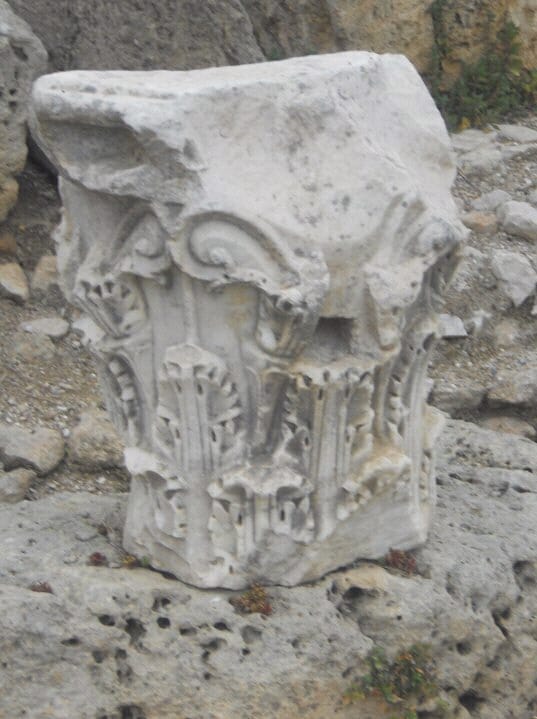
- Top picture: Ruins at the archaeological site of Ancient Corinth. Photo: Erik Drost, CC BY 2.0 (source)
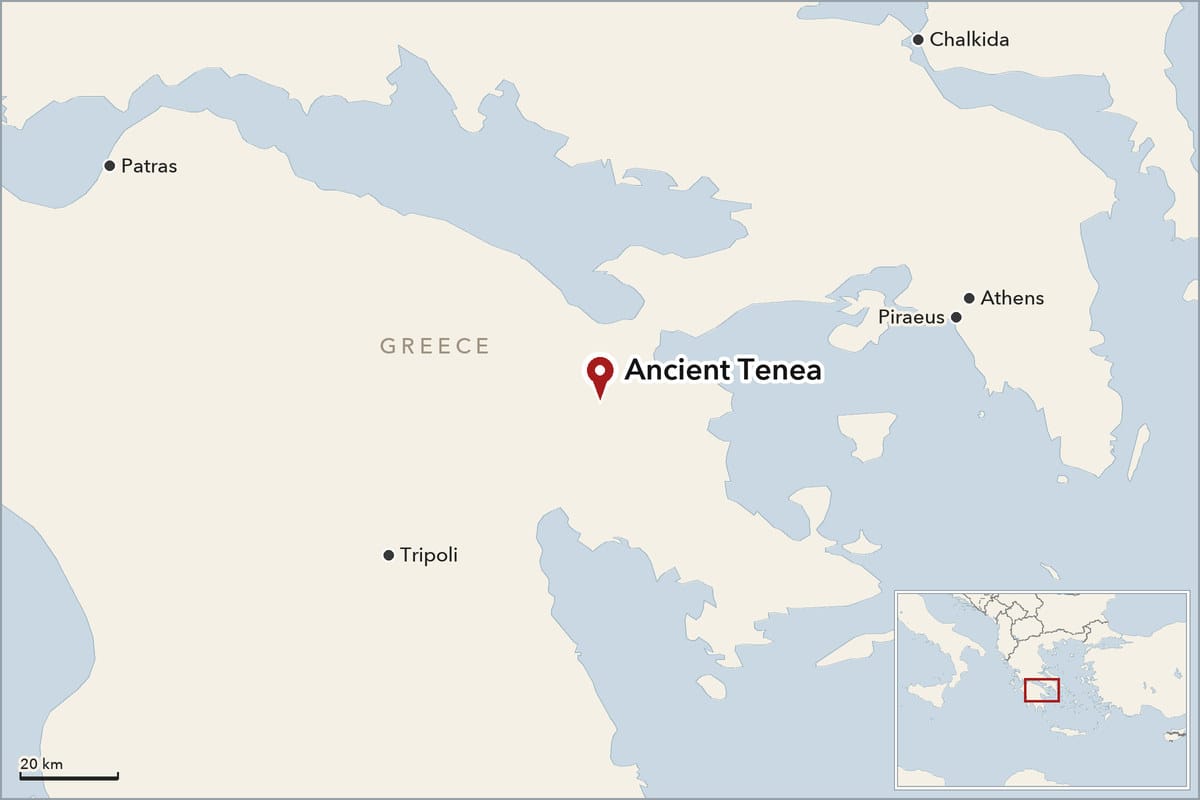
- Map: drawn from Natural Earth (public domain) and Wikidata.
