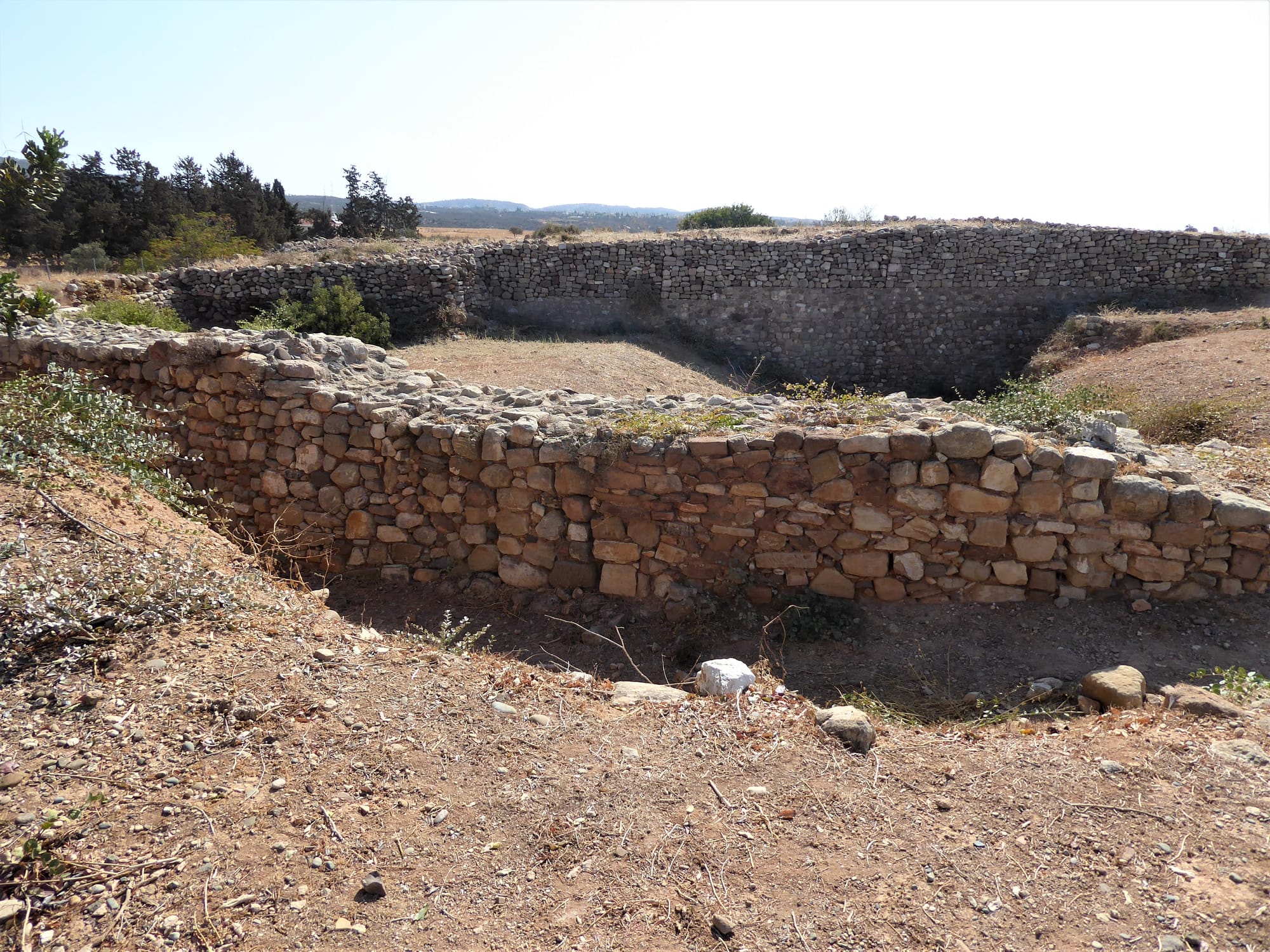
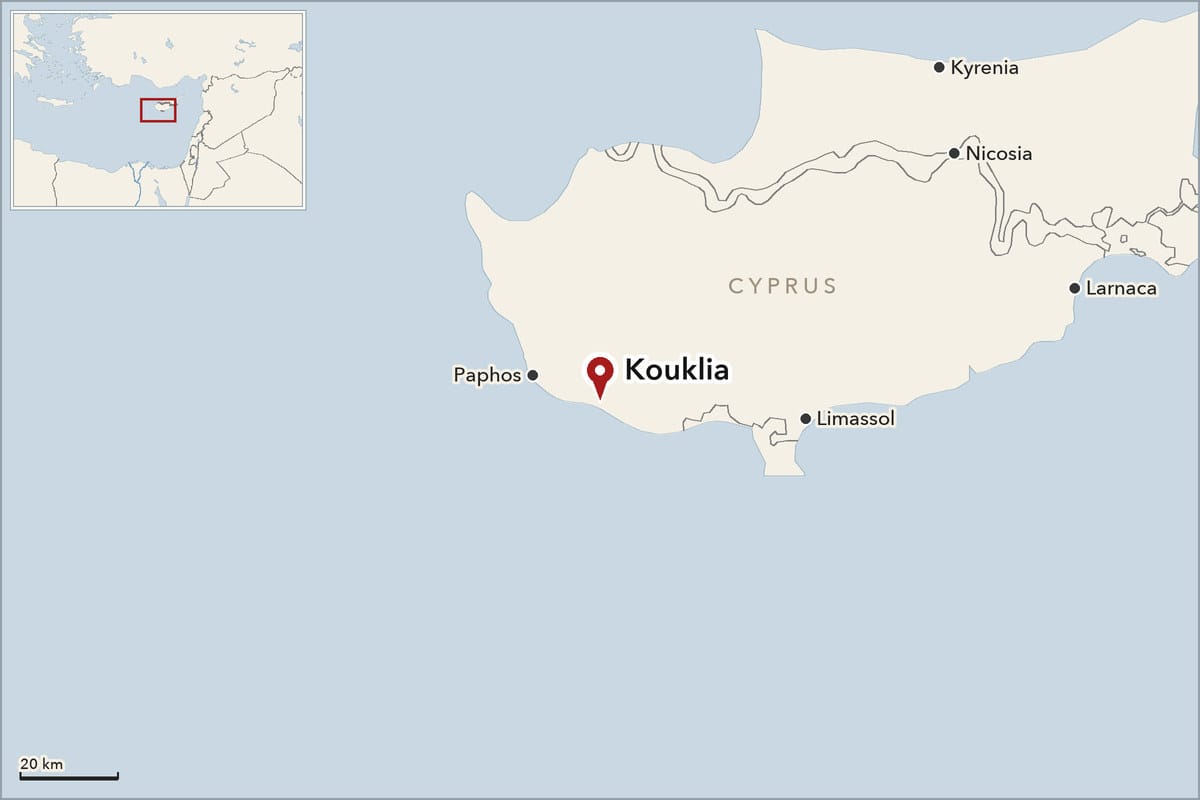
The Department of Antiquities of Cyprus says a team from the National and Kapodistrian University of Athens (NKUA) has found how a bastion on the defensive wall at Marchello, in Kouklia (ancient Palaepaphos), grew into a tower. It announced the result in a press release, dated 22 October 2026, marking the completion of the August–September 2026 excavation season. The Department said the findings establish the first Late Bronze Age fortification system identified at Palaepaphos.
The dig was directed by Professor Konstantinos Kopanias.
A wall whose date was never settled
Marchello lies just under 1 km north-east of the sanctuary of Aphrodite. British, German-Swiss and University of Cyprus excavations had already uncovered a long rampart, a monumental gate and other major remains there. According to the Department, important questions remained about when these structures were built and how they related to one another. NKUA has been digging at the site since 2021 to investigate its history further.
What the 2026 season found
The Department says the 2026 excavation gives stronger evidence that the earliest rampart dates to Late Cypriot IIC–IIIA, towards the end of the Late Bronze Age. Beside a newly exposed stretch of wall, the team uncovered an undisturbed deposit containing pottery of that period. On its surface lay a concentration of marl, which was apparently prepared there for construction. It was spread over the stone foundation to make a level base for the mudbrick wall above. The Department says the marl's close association with the pottery and foundations helps establish the date of the rampart's earliest phase.
The principal architectural find is a rectangular bastion, a structure projecting from the rampart, built in Late Cypriot IIIA. A three-sided extension was later added in front of it. Ancient Cyprus describes that addition as Π-shaped. Together the bastion and extension formed a nearly square structure of approximately 7.4 × 7.3 metres, with thick walls around a central chamber of about 9 square metres.
The Department says the square plan, thick walls and internal chamber support identifying it as a tower that could have carried upper levels. In its 22 October release, the Department said only the foundations survive, so the tower's original height remains unknown.
Reinforced again, centuries apart
The Department says the tower was strengthened again, probably still in Late Cypriot IIIA, when a wall about 2.7 metres thick was added to its north-western side. It reads these additions as showing that the defensive complex was developed and reinforced during the Late Bronze Age.
Centuries later, in the Late Cypro-Classical period of the fourth century BCE, another reinforcing wall went up along the tower's north-eastern and south-eastern sides. Pottery from its foundation trench provides the evidence for that date. The rampart was also widened at a later stage, possibly in the same period.
The gap the team has not closed
The Department says no Cypro-Geometric or Cypro-Archaic construction phase has yet been securely identified in the area NKUA excavated. Whether the fortifications stayed in continuous use between their Late Bronze Age construction and the later repairs is therefore, in the Department's words, still under investigation.
That gap is the honest limit of the find. The pottery and marl give stronger evidence that the first rampart belongs to the end of the Late Bronze Age, and the pottery in the foundation trench provides evidence that a later reinforcement dates to the fourth century BCE. What lies between the two is not yet filled by anything the team has securely identified. My view is that the headline claim, a Late Bronze Age fortification system at Palaepaphos, is well supported by the evidence the Department describes. The story of the wall across the long stretch after that is not yet told.
The Department says further research and study of the finds will help clarify how the defensive complex developed and where it sits in the history of Palaepaphos. At the end of the season the architectural remains were covered with ground-cover fabric for protection.
Sources
Drakopoulos, A. (2026) 'Late Bronze Age tower found on the city wall of Palaepaphos, near Aphrodite's sanctuary', Ancient Cyprus, 21 October 2026, available at: https://www.ancientcyprus.com/news/late-bronze-age-tower-marchello-kouklia (Accessed: 25 October 2026).
Department of Antiquities, Deputy Ministry of Culture, Republic of Cyprus (2026) 'Completion of the August-September 2026 excavation season at Marchello archaeological site, in Kouklia by the National and Kapodistrian University of Athens', GovCy, 22 October 2026, available at: https://www.gov.cy/en/culture/completion-of-the-august-september-2026-excavation-season-at-marchello-archaeological-site-in-kouklia-by-the-national-and-kapodistrian-university-of-athens/ (Accessed: 25 October 2026).
Hassett, B. (2026) 'Palaepaphos Bastion Reveals Late Bronze Age Defenses', Science.Report, 22 October 2026, available at: https://science.report/discover/palaepaphos-bastion-reveals-late-bronze-age-defenses-111031/ (Accessed: 25 October 2026).
Picture credits
- Top picture: Kouklia, Marcello Hill. Photo: Chris06, Wikimedia Commons (CC BY-SA 4.0)
- Photo: Nikodem Nijaki, CC BY-SA 3.0, via Wikimedia Commons
- Map: drawn from Natural Earth (public domain) and Wikidata.

