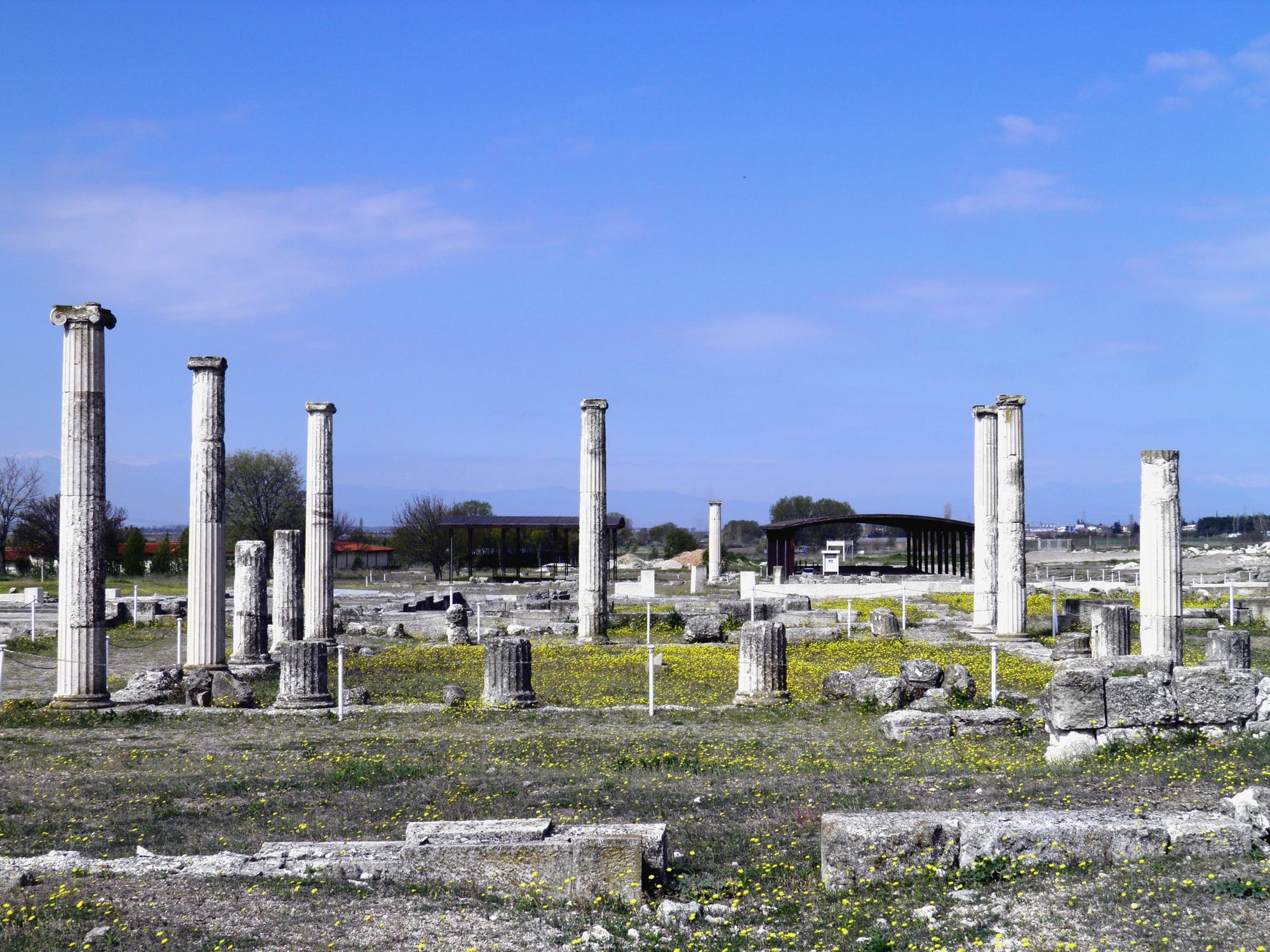
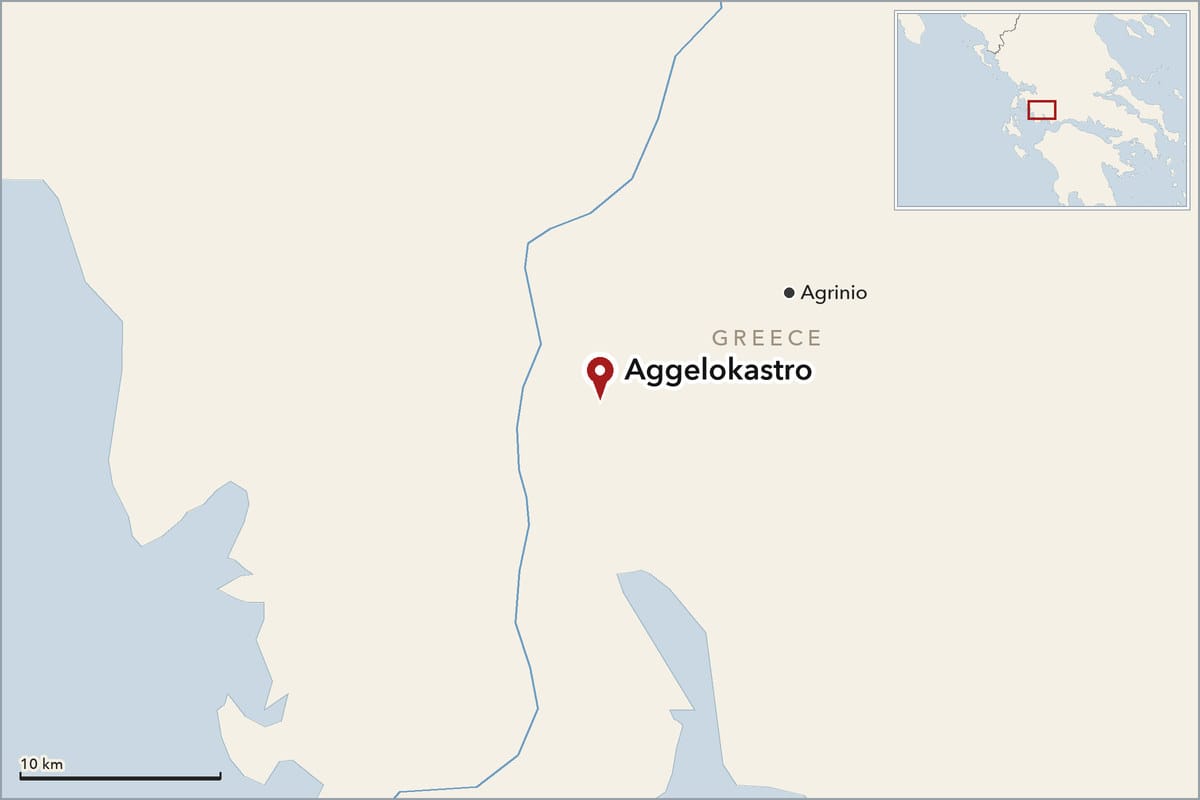
A joint Greek–Chinese team has finished the first season of a systematic excavation at ancient Arsinoe, at Angelokastro in Aitoloakarnania, western Greece. The Greek Ministry of Culture announced on Friday 16 October 2026 that fieldwork ended in July. The headline result is new evidence on a square building with a peristyle, a central courtyard surrounded by columns.
The programme
The excavation is the opening stage of a five-year programme running from 2026 to 2030. The Ministry of Culture is carrying it out with the Chinese School of Classical Studies at Athens and the Ephorate of Antiquities of Aitoloakarnania and Lefkada. Its stated aims are to investigate the ancient settlement, to study how it was planned and organised, and to examine its architectural remains.
Dr Olympia Vikatou, the Ministry's Secretary-General, directs the programme. Dr Li Xinwei, director of the Chinese School, leads the Chinese side. The Archaeology Newsroom site, reporting the Ministry's announcement, runs it under the subheading "The first Greek–Chinese excavation". La Brújula Verde reports that the Chinese daily Global Times describes it as the first field excavation the two countries have carried out together.
What was found at Kakavaria
The team worked at a spot called Kakavaria, where remains of ancient Arsinoe had come to light earlier. The 2026 season extended the older excavation, documented the remains and looked for new evidence on how the settlement was organised.
Particular attention went to a building parts of which the archaeologist Lazaros Kolonas had excavated in the past. According to the Ministry's announcement, the new data show a square building of careful construction with a peristyle courtyard, with traces of alterations and successive phases of use. The Ministry says it resembles buildings at other sites in Aitoloakarnania, such as ancient Kalydon. La Brújula Verde notes that the statement does not say which buildings at Kalydon it has in mind, or which features the comparison rests on.
The excavation also produced roof tiles, clay antefixes (decorative terracotta pieces for a roof), pottery vessels, bronze coins and animal remains. The Ministry says the finds are being treated and studied, and that identification and dating will follow. An inscription bearing the name Antifaneos, found at Arsinoe, is shown among the Ministry's images of finds from the dig.
What is not yet known
Nothing in the announcement gives a date for the building, and it does not say what the building was used for. La Brújula Verde puts it bluntly: nobody can yet say when it was built or what it was used for. Any date that circulates before the finds are identified and dated should be treated with caution.
A square plan with a columned courtyard and several phases of use is an interesting find. Without a date, it is not yet a story about who built it or why.
Why the name matters
Greek City Times reports that ancient writers, including Polybius and Strabo, describe a town in this area called Konope, which later took the name Arsinoe. It says that, according to Strabo, the settlement began as a village and was enlarged and renamed in honour of Arsinoe II, the Macedonian princess who became queen of Egypt as the wife of Ptolemy II. Some historians, the same report says, place the refoundation earlier, around 285–284 BC, when she was married to Lysimachus, king of Thrace.
Greek City Times adds that inscriptions and roof tiles stamped with the name of the Arsinoeans later confirmed the identification of the site, and that Angelokastro had never been excavated systematically until now. The Ministry's announcement describes this as the first excavation season of the systematic archaeological research at Angelokastro, part of a five-year programme.
The next four seasons
The Ministry says the programme will continue with further excavation and a study of the town's fortifications. It also plans geophysical methods, remote sensing, surface survey and geoarchaeological research, to understand the urban layout, history and development of ancient Arsinoe. Greek City Times reports that in June 2026, before the first season, the project partners said they would investigate about five hectares of land believed to hold the buried city.
On the wider project, La Brújula Verde reports that Li Xinwei told Global Times the site's riverside position suggests it may have been an important crossroads for travel and trade. The Ministry describes the first season as the starting point of an important international scientific collaboration, and says it expects the work to deepen knowledge of Arsinoe and strengthen Greece–China cooperation in archaeological research and the protection of cultural heritage.
Sources
Anamniseis (2026) 'Ελληνοκινεζική αρχαιολογική έρευνα στο Αγγελόκαστρο', Anamniseis, 16 October 2026, available at: https://www.anamniseis.net/ellinokineziki-erevna-sto-aggelokastro/ (Accessed: 21 October 2026).
Archaeology Newsroom (2026) 'Αρχαία Αρσινόη: Νέα στοιχεία για περίστυλο κτήριο', Αρχαιολογία Online, 16 October 2026, available at: https://www.archaiologia.gr/blog/2026/10/16/%CE%B1%CF%81%CF%87%CE%B1%CE%AF%CE%B1-%CE%B1%CF%81%CF%83%CE%B9%CE%BD%CF%8C%CE%B7-%CE%BD%CE%AD%CE%B1-%CF%83%CF%84%CE%BF%CE%B9%CF%87%CE%B5%CE%AF%CE%B1-%CE%B3%CE%B9%CE%B1-%CF%80%CE%B5%CF%81%CE%AF%CF%83/ (Accessed: 21 October 2026).
Carvajal, G. (2026) 'New Structures Have Been Discovered in Ancient Arsinoe, the Greek City that the Egyptian "Philadelphus" Queen Named after Herself in Aetolia', La Brújula Verde, 16 October 2026, available at: https://www.labrujulaverde.com/en/2026/10/new-structures-have-been-discovered-in-ancient-arsinoe-the-greek-city-that-the-egyptian-philadelphus-queen-named-after-herself-in-aetolia/ (Accessed: 21 October 2026).
Giannopoulos, B. (2026) 'Greek and Chinese Archaeologists Dig Into Ancient Arsinoe at Angelokastro', Greek City Times, 17 October 2026, available at: https://greekcitytimes.com/2026/10/17/angelokastro-arsinoe-excavation/ (Accessed: 21 October 2026).
HuffPost Greece (2026) 'Αγγελόκαστρο: Νέα ευρήματα στην αρχαία Αρσινόη', HuffPost Greece, 16 October 2026, available at: https://www.huffingtonpost.gr/culture/angelokastro-nea-evrimata-archaia-arsinoi/ (Accessed: 21 October 2026).
Picture credits
- Top picture: A peristyle is a central courtyard surrounded by columns. Image: The main courtyard of the House of Dionysos, Ancient Pella — Carole Raddato, CC BY-SA 2.0 (source)
- Map: drawn from Natural Earth (public domain) and Wikidata.
