
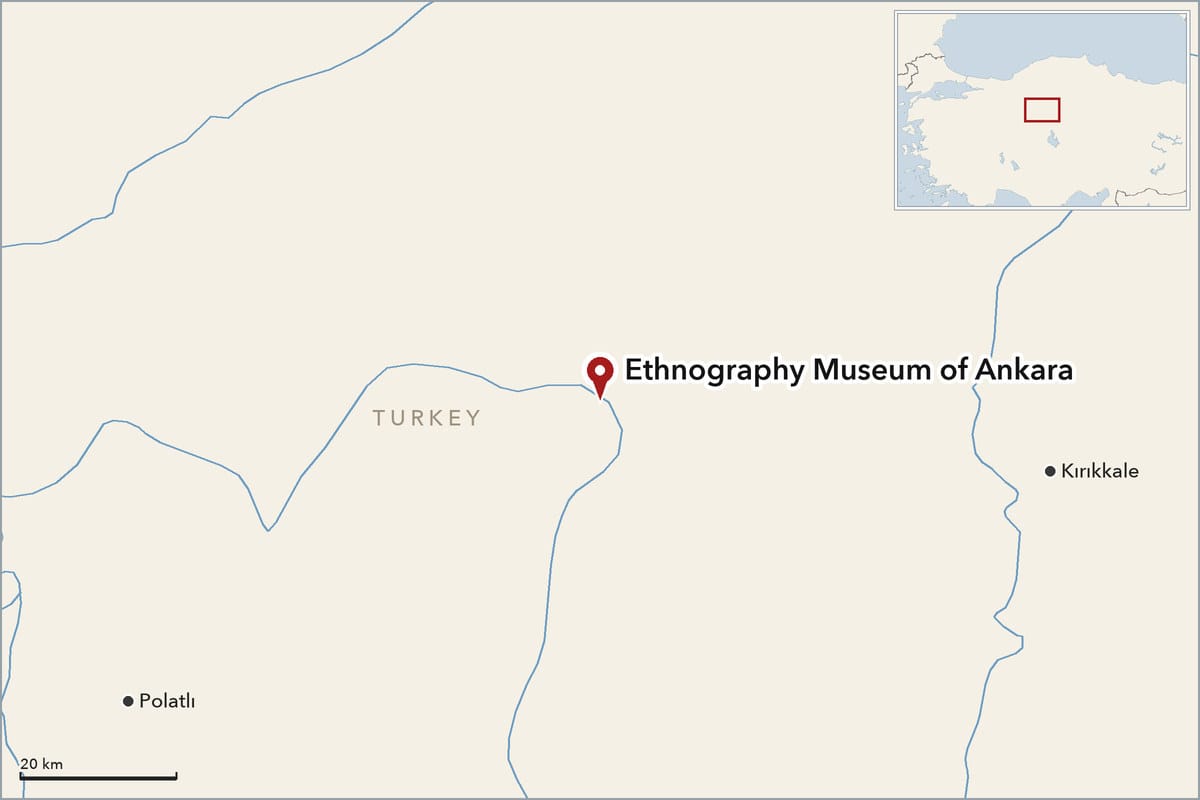
Melih Arslan and Ahmet Emirhan Bulut published their study of the ring in the journal Cedrus on 29 October 2026. The stone is a carnelian set in an iron ring, and it belongs to the Gaye Çarmıklı Collection at the Ankara Ethnography Museum. The authors date it to the first half of the 1st century BC, and their abstract says the scene it shows "may derive from a satyr play or theatrical performance".
Five figures on a small stone
The reddish-caramel stone measures just 13 by 11 millimetres. The composition features five primary figures, including several satyrs, some of them depicted with horns and carrying curved staffs. In the middle, a seated man in a long garment looks at a two-leaf tablet, and the authors suggest he may be the playwright or a poet. Facing him, according to Arkeonews, is a figure resting one foot on a stone, who may lead the satyr chorus.
The other figures have tails and rest the staffs on their shoulders, features that mark them as satyrs, the mythical creatures associated with Dionysus. At the far left is a bearded herm of Dionysus, which the authors read as both decoration and a symbolic reference to the theatre. Arkeonews reports that the researchers see a small female figure behind the herm as possibly Thalia, the Muse of comedy, though it adds that her identity is not yet definitive.
A rehearsal or the play itself?
The study notes that engraved gems showing theatrical performances are exceptionally rare, and that those known usually show a rehearsal, with the actors holding their masks above their heads instead of wearing them. The researchers compared the Çarmıklı ring stone with similar pieces in the British Museum and the Rijksmuseum van Oudheden in the Netherlands. Among the study's listed electronic sources is a sard ring stone with a depiction of a theatre play in the British Museum, registration number 1913,0307.186.
On the Çarmıklı stone, by contrast, the figures are shown without masks, and the authors say they seem to be portrayed as satyrs themselves. Arslan and Bulut argue that this detail may indicate the scene represents the play itself, or its narrative, rather than a rehearsal. Arkeonews reports that, according to the researchers, the direct depiction of satyrs offers a previously undocumented iconographic approach among known theatrical reliefs.
According to Arkeonews, satyr plays mixed tragic subject matter with humour, usually had a chorus of satyrs, formed an important part of Athenian festivals from the 5th century BC and later survived as stand-alone performances; the only one to survive complete is Euripides' Kyklops. GreekReporter, in its coverage, refers to a recent study that examined why ancient Athens preserved Greek tragedies but may have neglected satyr plays.
How it was made and what condition it is in
The figures were cut into the surface of the stone as an intaglio. Arkeonews reports that the researchers found marks of round-tipped drills along the outlines of the bodies, and rotary abrasives of different thicknesses in the folds of the clothing. Arkeonews adds that small perforations were used to form the noses.
Little of the iron ring survives: Arkeonews reports that only a badly corroded fragment of the shank remains. Arkeonews reports that although the carnelian shows two fine cracks and some wear, all figures remain legible. Arkeonews also reports that the researchers dated the object through its form, technical attributes and comparison with similar artefacts, and that small drill marks, the treatment of clothing folds and the stone's material all support a date in the early half of the 1st century BC.
Where it came from, and who owned it
The museum's records point to a possible origin near Sardis, but with no known find-spot or archaeological context, that cannot be confirmed. Arkeonews reports that because the piece did not arise from a controlled archaeological excavation, its provenance is difficult to trace. It is unknown who owned the ring.
Arslan and Bulut think the ring's owner may have been a theatre professional or someone keenly interested in the performing arts, though the carvings are not enough to identify the owner for certain.
The study's description says its detailed examination of the intaglio aims to make a significant contribution to the iconography of Anatolian gemstones and the visual history of the performing arts. GreekReporter writes that although its original owner remains a mystery, the gemstone offers rare evidence of how ancient Greek theatrical traditions appeared on personal jewellery.
Sources
Altuntaş, L. (2026) '2,100-Year-Old Ring Stone Depicts an Ancient Theater Scene in Just 13 Millimeters', Arkeonews, 3 November 2026, available at: https://arkeonews.net/2100-year-old-ring-stone-depicts-an-ancient-theater-scene-in-just-13-millimeters/ (Accessed: 9 November 2026).
Melih, A. (2026) 'A Rare Ring Stone Depicting a Satyr Play', Zenodo, 29 October 2026, available at: https://zenodo.org/records/22642626 (Accessed: 9 November 2026).
Zahid, N. (2026) '2,100-Year-Old Gemstone Reveals Rare Scene From Ancient Greek Theater', GreekReporter.com, 4 November 2026, available at: https://greekreporter.com/2026/11/04/gemstone-rare-scene-ancient-greek-theater/ (Accessed: 9 November 2026).
Picture credits
- Top picture: The Ankara Ethnography Museum; the ring stone belongs to the Gaye Çarmıklı Collection there. Photo: Dosseman (CC BY-SA 4.0), via Wikimedia Commons
- Map: drawn from Natural Earth (public domain) and Wikidata.
