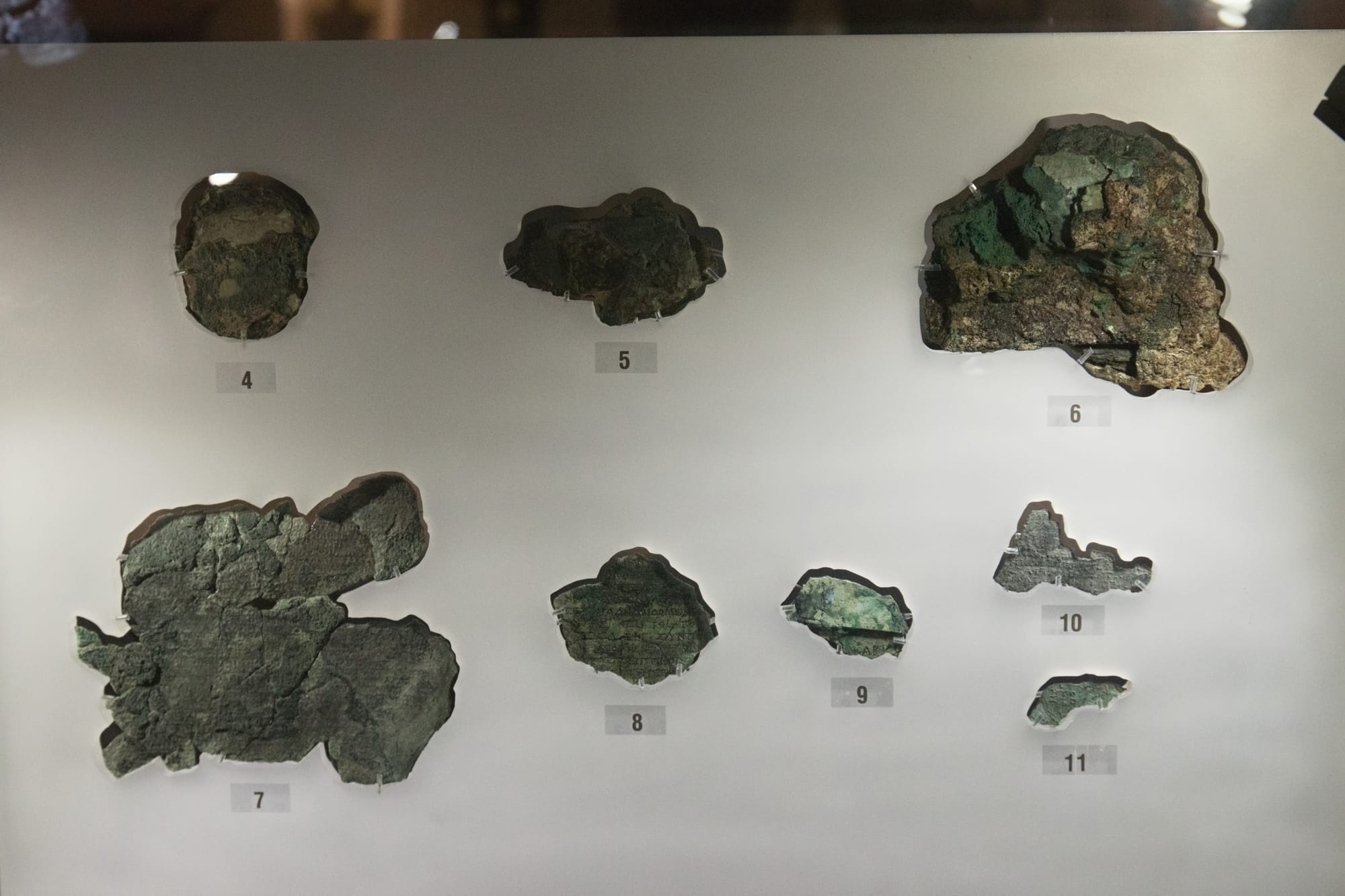
Above: The Antikythera Mechanism, identified in 1902 and dubbed the world's oldest known computer. (Antikythera Mechanism, photo: Zde, CC BY-SA 4.0 (Wikimedia Commons))
The Antikythera wreck has been on the books for a century and a quarter. A Roman ship, perhaps fifty metres from bow to stern, sailing from Asia Minor to Rome with a cargo of more than four dozen bronze and marble statues, amphorae, and portable luxury goods. It went down in the Aegean and the cargo scattered across the seafloor. Since sponge divers first broke the surface of it in 1900, the salvage has been partial, piecemeal, and — by the numbers — incomplete.
The site sits under the jurisdiction of the Greek Ephorate of Underwater Antiquities. The 2017 excavation ran under the aegis of the President of the Hellenic Republic, financed through Lund University in Sweden and the non-profit Argo, with support from Hublot, the Swordspoint Foundation, Autodesk, COSMOTE, and others. That is a considerable amount of institutional architecture for a shipwreck where, by the team's 2017 estimate, at least seven life-size statues could be hidden near the boulders.
The most celebrated find came not from the sea but from a museum bench. On 17 May 1902, archaeologist Valerios Stais was studying the artefacts at the National Archaeological Museum in Athens when he identified the Antikythera Mechanism — a device many regard as the world's oldest known analog computer. It had been pulled from the wreck in the original 1900–01 salvage and sat, unrecognised, in a collection of corroded bronze fragments.
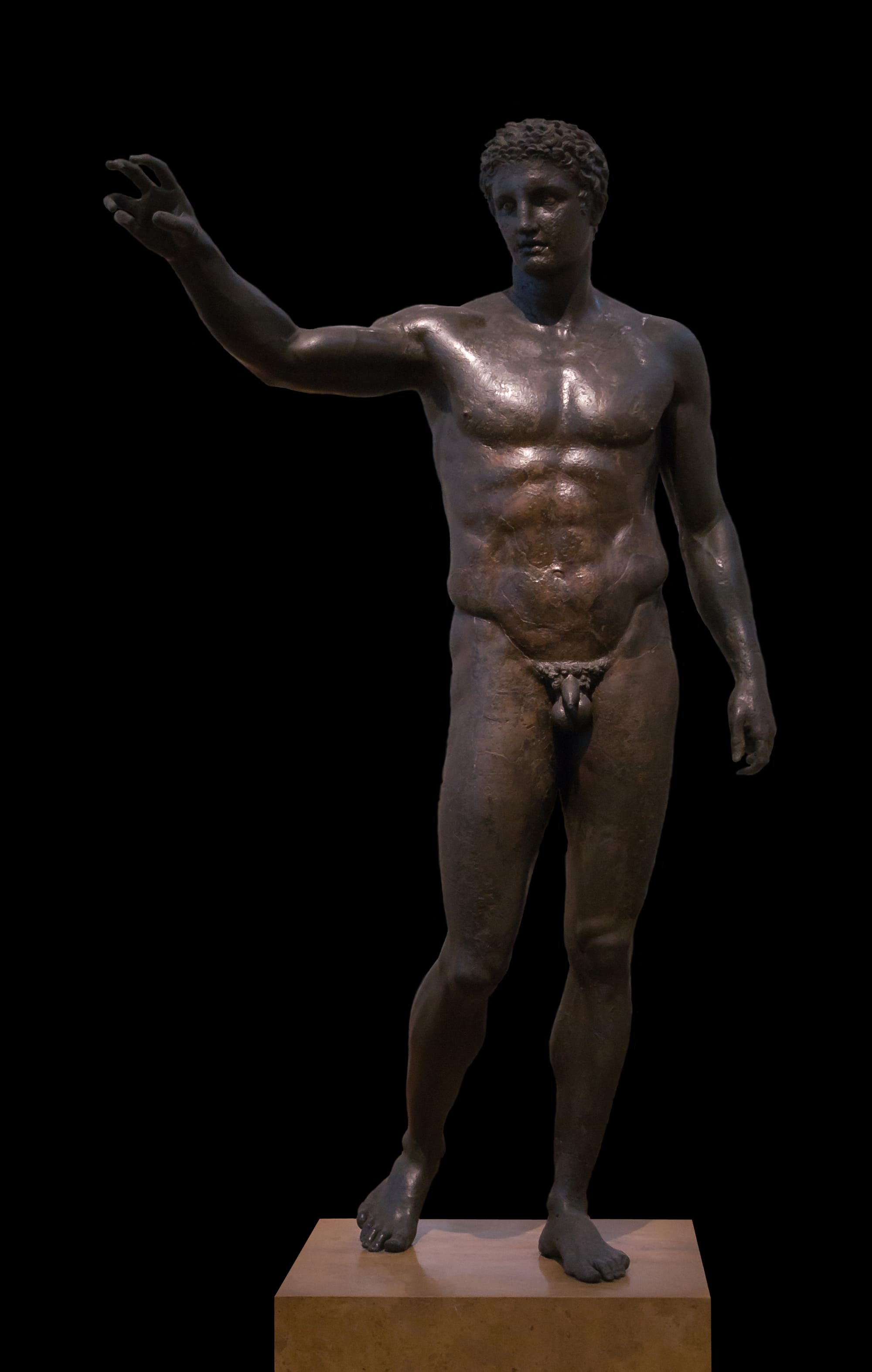
The bronze Antikythera Youth is dated to around 340 BC, centuries older than the ship itself. One recent study dates most of the statuary to the second and early first centuries BC, and the Antikythera Philosopher is dated by most researchers to the Middle Hellenistic period, though the Guardian puts it in the fourth century BC. The ship sank in the middle decades of the first century BC: Brian Martens, writing in the Annual of the British School at Athens in 2025, puts the loss at "c. 70–50 BCE, possibly later", and Wikipedia's entry on the wreck dates it to "the second quarter of the first century BC".
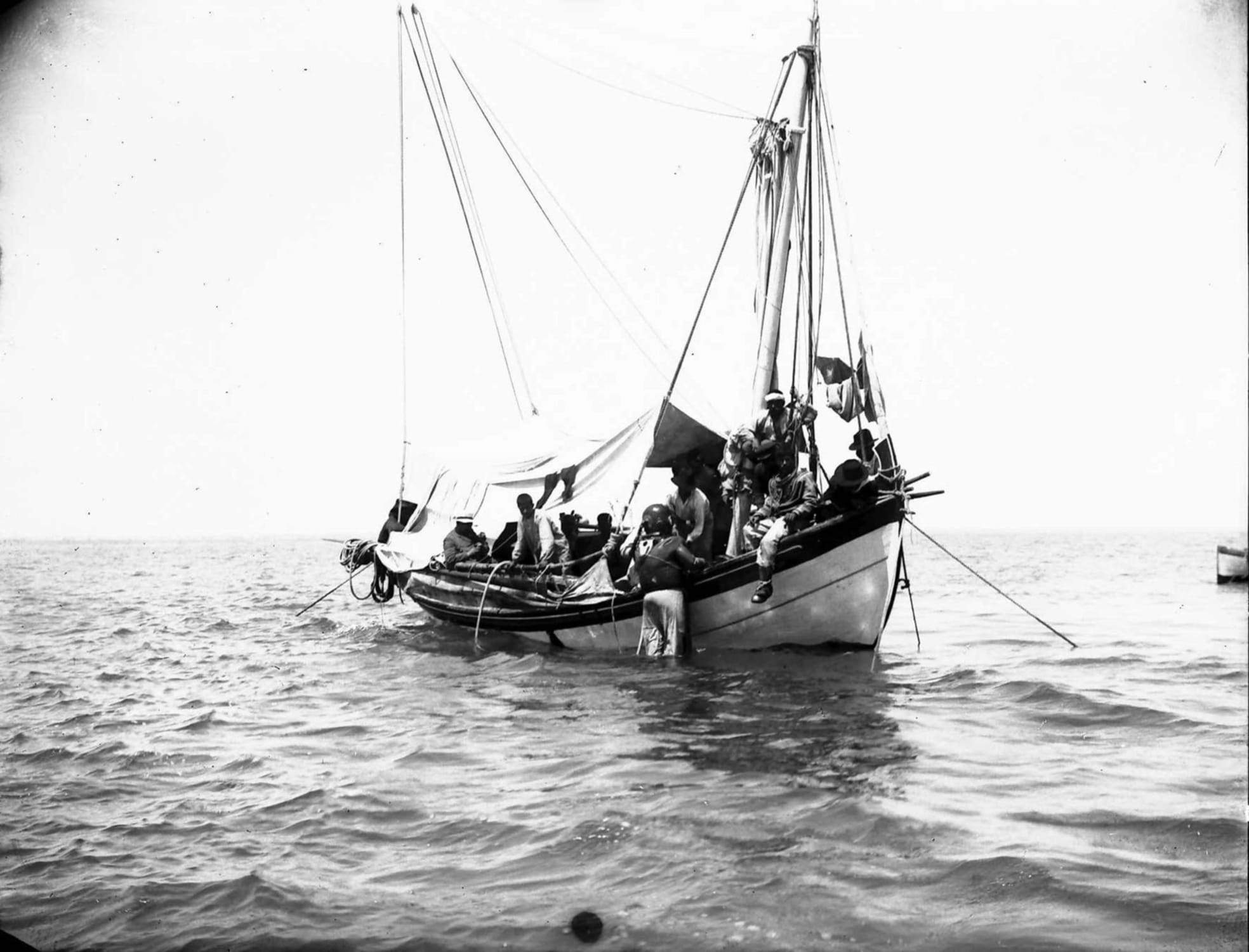
The 2017 season, which ran from 4 to 20 September under excellent weather conditions, is where the story gets interesting. Lund University describes the excavation as co-led by its marine archaeologist Brendan Foley and Theotokis Theodoulou of the Greek Ephorate of Underwater Antiquities; the Ephorate's own press release says the work was directed by the Ephorate under its head, Aggeliki Simossi, with Theodoulou and Dimitris Kourkoumelis as scientific leaders in the field and Foley among the team. The divers worked a trench where human remains had been recovered the previous year and meanwhile extended the excavation to two more areas where marble and bronze statue fragments lay under large stone boulders. The same release attributes the boulders' presence to "a severe seismic event."
Under those boulders, the team found a bronze arm and two marble feet attached to a plinth. That was enough for Foley to say, in the words Lund University published, that the find was "an indication that the missing six bronze sculptures represented in the National Archaeological Museum by pieces recovered in the original 1901 salvage operation, are surely waiting for us to find them." The team's broader conclusion, as Lund reported it: that "at least seven life-size statues could be hidden nearby."
Note the language. Could be hidden. An indication. Surely waiting for us to find them. This is not a count. It is not a recovery. It is a team that found a bronze arm and two marble feet under the boulders, with a metal detector picking up other large metal objects nearby, and concluded that there is probably more down there. Nature's preview of the same story put it plainly: "Archaeologists think that at least seven life-sized sculptures are hidden nearby." Think. Not confirmed. Not recovered. Not even counted.
The same season produced a more tantalising object. A bronze disc with four holed protrusions, decorated with a bull — a detail visible only after X-ray imaging. The team's first hope, as Lund University put it, was that it could be "the missing gear from the Antikythera mechanism." Preliminary X-ray images showed no teeth, suggesting it was not a gear but a decorative item. The disc was to "undergo further investigation." That was 2017.
The 2017 season also turned up a patterned slab of red marble, a silver tankard, sections of joined wood from the ship's frame, and a human bone. In 2016, the team had found a human skeleton well-preserved enough for potential DNA recovery. Foley named the individual "Pamphilos," after a common Greek name meaning "friend of all" that had been scratched into a cup decorated with an erotic scene.
A five-year comprehensive survey program began at the site in 2021, and the Ephorate's campaign there, carried out with the Swiss School of Archaeology in Greece, concluded in 2025. In 2022 three 8.5-ton boulders that had partially covered the wreck were removed, permitting further discoveries, including human teeth. The program also recovered the head of a marble statue, possibly the missing head of a Hercules statue recovered earlier from the same site; Brian Martens, in a 2025 study, says a bearded head recovered in 2022 very probably belongs to the colossal Farnese-type Herakles, though, as of that study, the pieces had not yet been brought together.
Here is what the story adds up to. A Roman ship sank in the middle decades of the first century BC with an extraordinary cargo. The original 1900–01 salvage recovered much of it, but not all. The Antikythera Mechanism, the most famous object in that cargo, was identified in a museum in May 1902, the year after the salvage ended. Since then, work at the site has been episodic — Cousteau in 1953 and 1976, a survey in 2012, excavations from 2014 to 2017 and in 2019, then a five-year program from 2021 to 2025. The work has produced real finds: hull fragments, statue pieces, pottery, a human skeleton, a mystery disc. But the 2017 estimate of at least seven hidden statues was just that: a belief. A "could be hidden nearby."
A century and a quarter after sponge divers first found the wreck in 50 metres of water, there is no confirmed count of the cargo still on the seafloor. In 2017, Foley told the Guardian the team thought it meant "a minimum of seven, and potentially nine, bronze sculptures still waiting for us down there." In 2022 three 8.5-ton boulders that had partially covered the wreck were removed. The 2017 plan had been to return in May 2018 and break up the boulders.
Sources
Lund University (2017) 'Antikythera shipwreck yields remarkable artifacts', 5 October 2017, available at: https://www.lunduniversity.lu.se/article/antikythera-shipwreck-yields-remarkable-artifacts (Accessed: 6 October 2026).
Greek Ephorate of Underwater Antiquities (2017) 'Press release about the 2017 expedition', Return to Antikythera project, 4 October 2017, available at: https://antikythera.org.gr/2017/10/04/2288/ (Accessed: 6 October 2026).
Marchant, J. (2017) 'Antikythera shipwreck yields statue pieces and mystery bronze disc', Nature, 4 October 2017, DOI: https://doi.org/10.1038/nature.2017.22735, available at: https://www.nature.com/articles/nature.2017.22735 (Accessed: 6 October 2026).
The Guardian (2017) 'Antikythera shipwreck yields bronze arm – and hints at spectacular haul of statues', 4 October 2017, available at: https://www.theguardian.com/science/2017/oct/04/antikythera-shipwreck-yields-new-treasures-and-hints-of-priceless-classical-statues (Accessed: 6 October 2026).
The Guardian (2016) 'DNA from the deep? Antikythera shipwreck yields ancient human bones', 19 September 2016, available at: https://www.theguardian.com/science/2016/sep/19/antikythera-shipwreck-yields-human-bones-bringing-hope-for-dna-secrets-from-the-deep (Accessed: 6 October 2026).
Martens, B. (2025) 'A Gymnasion Assemblage Lost at Sea? The Statues from the Antikythera Shipwreck Reconsidered', Annual of the British School at Athens, 120, published online 29 September 2025, DOI: https://doi.org/10.1017/S006824542510021X (Accessed: 6 October 2026).
Wikipedia (n.d.) 'Antikythera wreck', available at: https://en.wikipedia.org/wiki/Antikythera_wreck (Accessed: 6 October 2026).