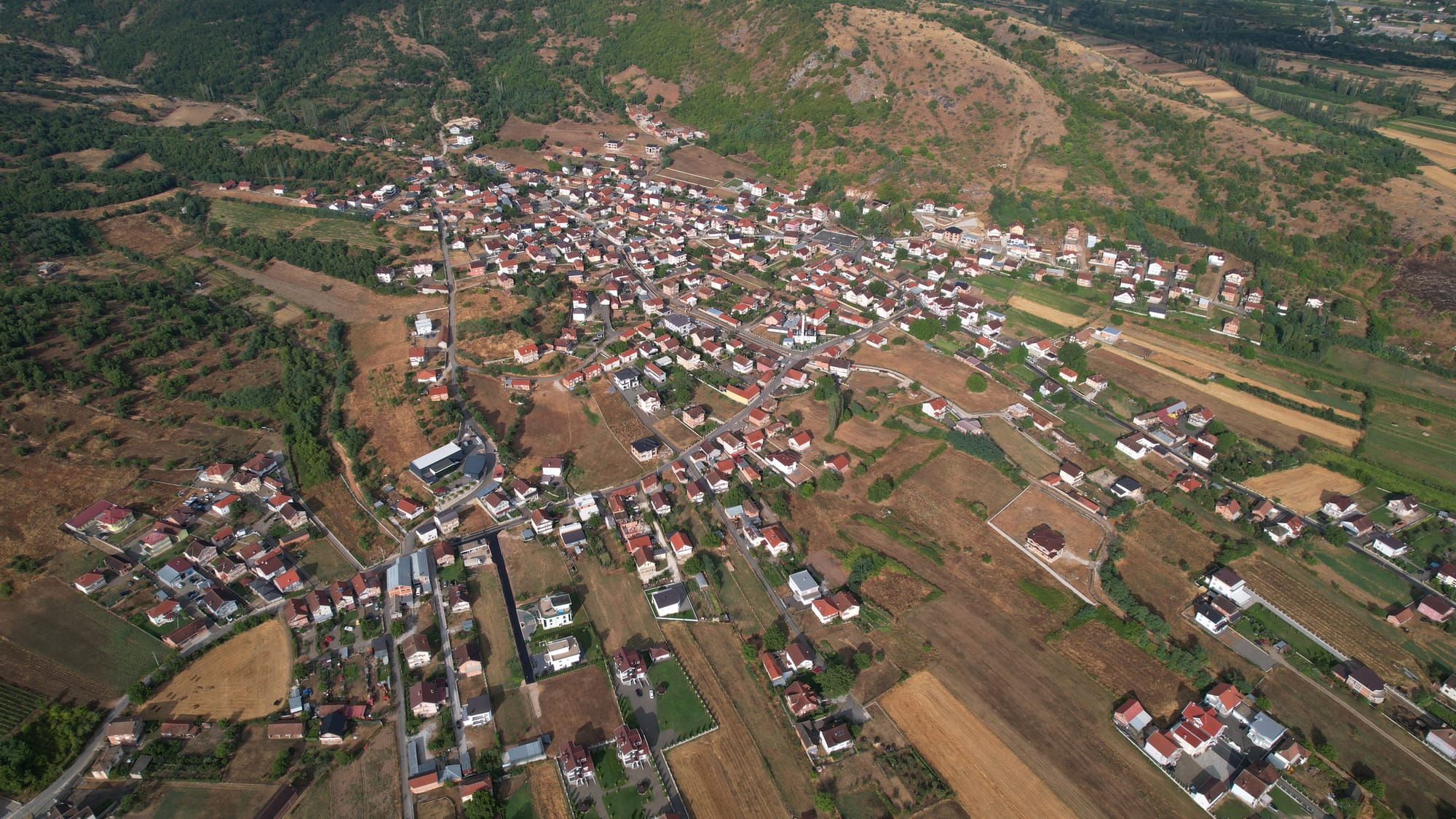
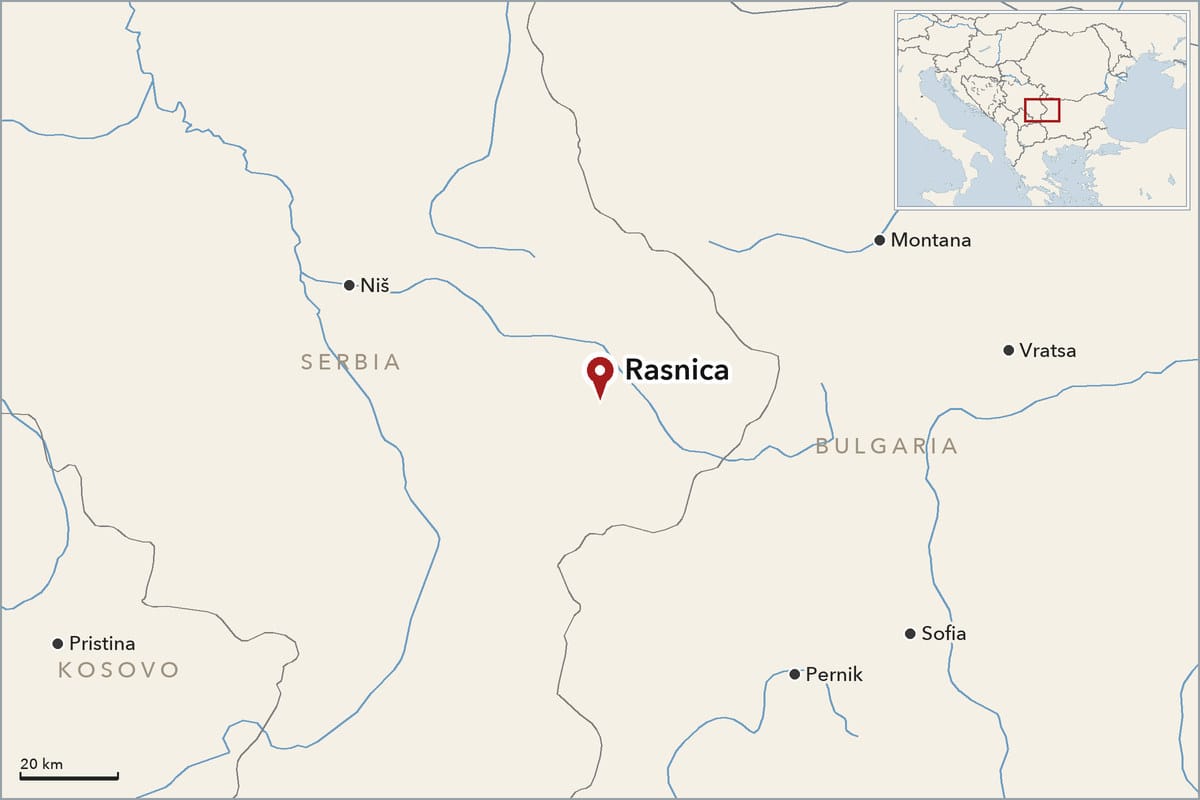
On 5 October 2026, North Macedonia's National Archaeological Museum announced a rich warrior burial at Rasnica, an Archaic-period necropolis near the village of Koroshishta, in the municipality of Struga. The Macedonian news agency MIA reported that the grave held a complete set of military equipment and lay in an undisturbed archaeological context. The grave is dated to the sixth century BC.
One detail has run ahead of the announcement: a thin sheet of gold that may have covered the dead person's face. Here is what is firmly on the record and what is still a hypothesis.
What the museum announced
The Macedonian wire reports of the announcement (MIA, OhridPress and Makfax, the last carried by Tocka) list a shield, helmet, spears and a sword. OhridPress and Makfax also mention other objects of gold, bronze and amber. Tocka attributes the announcement to the Ministry of Culture. MIA and OhridPress attribute it to the museum.
The museum says the new finds confirm Rasnica as an Archaic-period necropolis. OhridPress reports the museum describing that confirmation as unequivocal. The museum also says the grave and its weapons will allow a more precise reading of the status, identity and military role of some of the people buried there.
The excavation is run by the National Archaeological Museum in Skopje, working with the Institute for the Protection of Cultural Monuments and Museum in Ohrid and the Cultural Heritage Protection Office, according to Tocka. Dr Pero Ardžanliev, a curator-adviser at the museum, leads the project.
Older than the 2024 tomb
MIA reports that, on first assessment, the new burial is older than the exceptional find made at the same site in 2024. Ardžanliev, MIA says, based this on the characteristics of the finds and a preliminary chronological analysis.
The 2024 find was a monumental burial complex. The museum's list of its contents, as reported by OhridPress, includes a bronze helmet with gold applications, a bronze shield, gold rings and foils, amber and glass beads, silver pins and several bronze vessels.
The museum said, as MIA reports, that the 2026 grave shows Rasnica is not an isolated find but a complex with exceptional scientific potential.
The gold foil: a lead, not a conclusion

The detail that has drawn attention comes from Arkeonews. It says archaeologists found a thin sheet of gold beside the shield and believe it may originally have covered the face of the deceased. Arkeonews also itemises further finds from the grave: a bronze helmet, bronze vessels, a silver pin, amber and glass beads and a gold ring.
Arkeonews is careful about the foil. It reports that the object was extremely delicate and had yet to undergo conservation. Researchers, it reports, are withholding a more precise identification until specialists can examine its original shape and construction in the laboratory. It also reports that anthropological analysis has not yet established the sex or age of the deceased, and that researchers hope to test for a biological relationship with the person from the 2024 tomb.
My view: "may originally have covered the face", as Arkeonews puts it, is a long way from a funerary mask. Until conservators have examined the foil, it is a promising lead and no more. The grave's weapon set, by contrast, is what the museum itself announced.
Why Trebeništa matters
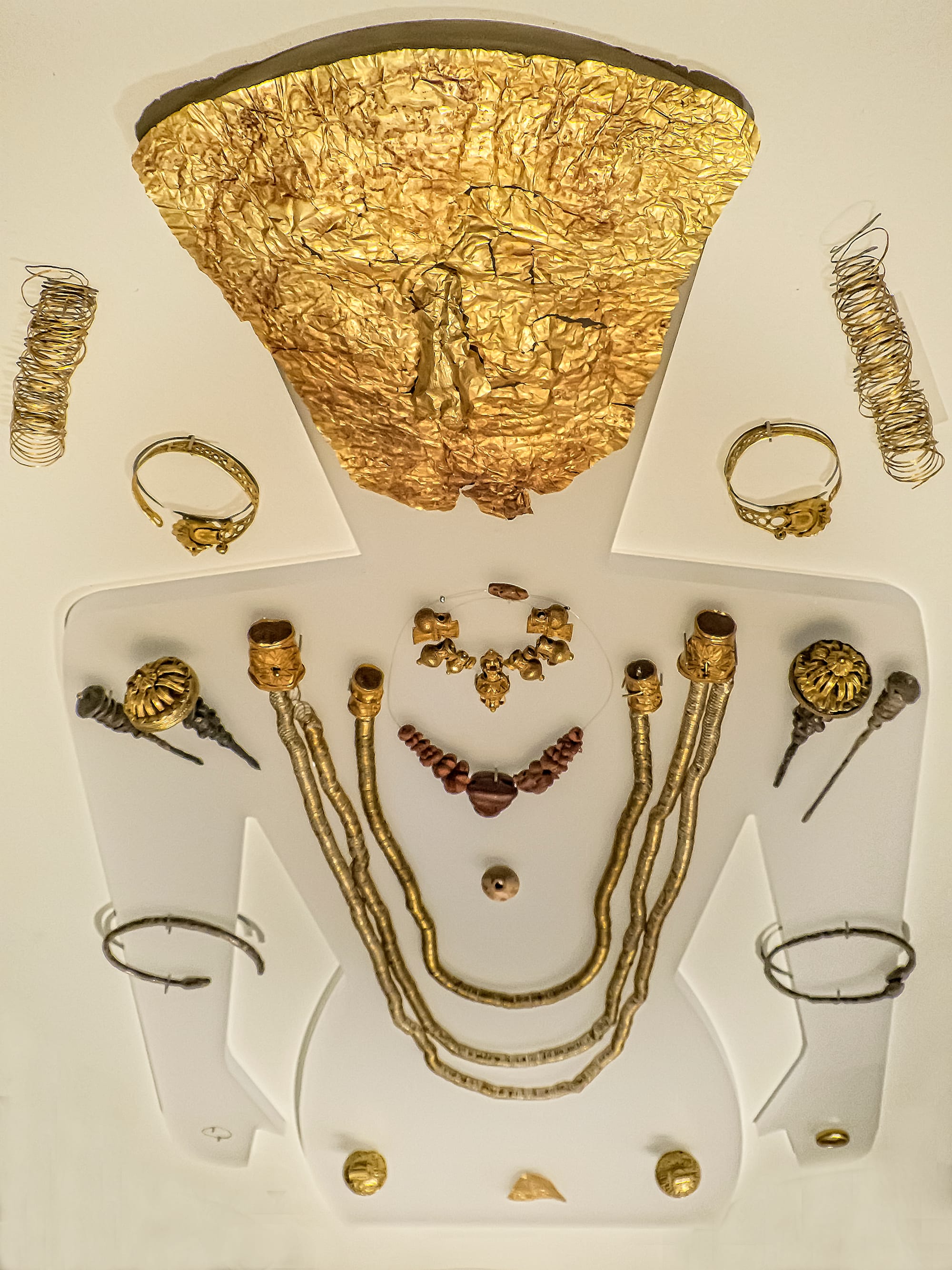
Arkeonews says Rasnica lies only about five kilometres from Trebeništa, the famous necropolis whose wealthy graves produced gold funerary masks, jewellery, weapons and imported vessels. It adds that Ardžanliev noted that preliminary observations may even place the Rasnica gold foil earlier than comparable material from Trebeništa. It says more work is needed to establish how the two cemeteries relate. Goran Patchev, director of the Institute and Museum in Ohrid, also set the results against the rich burial complexes already known in the region, with Trebeništa at the centre, according to MIA.
Gold mask burials are already a disputed subject. In a paper published online on 18 June 2026 in the Cambridge Archaeological Journal, Stefanos Gimatzidis of the Austrian Archaeological Institute notes that several Balkan countries claim the phenomenon as shared heritage. He describes the discovery at Trebenishte, near Lake Ohrid, shortly before the end of the First World War. He argues that the practice grew out of earlier, more modest gold sheets placed over the mouth, and that full masks and mouthpieces appeared in parallel in the Late Archaic period. He also argues against direct links to Macedonian ethnicity and concludes that the custom spread through small- to medium-scale mobility rather than large-scale invasions.
Arkeonews takes a similar line about Rasnica itself. It says the precise cultural and political identity of the people buried there remains a subject for research, and that the finds are more useful as evidence of a powerful local elite than when forced into later ethnic or national categories.
What happens next
At the 5 October press conference, museum director Magdalena Manaskova said the results so far, and the site's potential, call for Rasnica's research to continue as systematic excavation with a long-term scientific programme, MIA reports. Vesela Chestoeva, director of the Cultural Heritage Protection Office, said her office would put information to the government to secure continuity and funding for further research, protection and expert treatment of the site and its finds, according to MIA.
The museum said the finds will undergo detailed archaeological, conservation and interdisciplinary analysis. The gold foil is the first thing to watch in that process.
Sources
Altuntaş, L. (2026) 'A 2,600-Year-Old Warrior Buried With a Helmet, Sword, Shield and Gold Face Covering Found in North Macedonia', Arkeonews, 5 October 2026, available at: https://arkeonews.net/a-2600-year-old-warrior-buried-with-a-helmet-sword-shield-and-gold-face-covering-found-in-north-macedonia/ (Accessed: 22 October 2026).
Gimatzidis, S. (2026) 'Gold Mask Burials in Archaic Macedonia: Between Mortuary Practice and Social Performance', Cambridge Archaeological Journal, published online 18 June 2026, DOI: 10.1017/S0959774326100663, available at: https://www.cambridge.org/core/journals/cambridge-archaeological-journal/article/gold-mask-burials-in-archaic-macedonia-between-mortuary-practice-and-social-performance/9E4C96F3177C8A41C37C3CD277AF8C25 (Accessed: 22 October 2026).
Makfax (2026) 'Нови пронајдоци на локалитетот Расница: Откриено богато војничко погребување од VI век', Tocka.com.mk, 5 October 2026, available at: https://tocka.com.mk/vesti/573667/novi-pronajdoci-na-lokalitetot-rasnica-otkrieno-bogato-vojnicko-pogrebuvanje-od-vi-vek (Accessed: 22 October 2026).
OhridPress (2026) 'Нови исклучителни откритија на архајската некропола кај струшко Корошишта', OhridPress, 5 October 2026, available at: https://ohridpress.com.mk/%D0%BD%D0%BE%D0%B2%D0%B8-%D0%B8%D1%81%D0%BA%D0%BB%D1%83%D1%87%D0%B8%D1%82%D0%B5%D0%BB%D0%BD%D0%B8-%D0%BE%D1%82%D0%BA%D1%80%D0%B8%D1%82%D0%B8%D1%98%D0%B0-%D0%BD%D0%B0-%D0%B0%D1%80%D1%85%D0%B0%D1%98/ (Accessed: 22 October 2026).
Stojkova-Kostoski, S. (2026) 'Богато војничко погребување со комплетна воена опрема откриени на архајската некропола кај Корошишта', MIA, 5 October 2026, available at: https://mia.mk/en/story/%D0%B1%D0%BE%D0%B3%D0%B0%D1%82%D0%BE-%D0%B2%D0%BE%D1%98%D0%BD%D0%B8%D1%87%D0%BA%D0%BE-%D0%BF%D0%BE%D0%B3%D1%80%D0%B5%D0%B1%D1%83%D0%B2%D0%B0%D1%9A%D0%B5-%D1%81%D0%BE-%D0%BA%D0%BE%D0%BC%D0%BF%D0%BB%D0%B5%D1%82%D0%BD%D0%B0-%D0%B2%D0%BE%D0%B5%D0%BD%D0%B0-%D0%BE%D0%BF%D1%80%D0%B5%D0%BC%D0%B0-%D0%BE%D1%82%D0%BA%D1%80%D0%B8%D0%B5%D0%BD%D0%B8-%D0%BD%D0%B0-%D0%B0%D1%80%D1%85%D0%B0%D1%98%D1%81%D0%BA%D0%B0%D1%82%D0%B0-%D0%BD%D0%B5%D0%BA%D1%80%D0%BE%D0%BF%D0%BE%D0%BB%D0%B0-%D0%BA%D0%B0%D1%98-%D0%BA%D0%BE%D1%80%D0%BE%D1%88%D0%B8%D1%88%D1%82%D0%B0 (Accessed: 22 October 2026).
Picture credits
- Top picture: An aerial view of the village of Koroshishta. Image: Aerial view of Koroshishta: Dejan Lazarevski, CC BY-SA 4.0, via Wikimedia Commons
- Lake Ohrid. Image: Lake Ohrid: Ptahhotep, CC BY-SA 4.0, via Wikimedia Commons
- Gold grave goods and death mask from the tomb of the Lady of Sindos 510-500 BCE Macedonian Archaeological Museum of Thessaloniki. Image: Gold funerary mask (tomb of the Lady of Sindos): Mary Harrsch, CC BY-SA 4.0, via Wikimedia Commons
- Map: drawn from Natural Earth (public domain) and Wikidata.


