The framing
On Monday, 28 September 2026, President Konstantinos Tasoulas and Culture Minister Lina Mendoni attended the inauguration of restoration works at ancient Nicopolis, which TOVIMA reported had been "returned to the local community." TOVIMA described the occasion as following the completion of "major protection, restoration, conservation and enhancement projects." The Greek City Times ran the headline as an update: "President Tasoulas opens restored Nicopolis as UNESCO file moves forward."
"Returned." "Opened." "Restored." These are words of closure, of a job finished. And for the palace complex, the basilica mosaics, and the road bypass, that closure is real. The work is complete and the site has been returned to the public.
But the Great Theatre — the monument the ministry itself calls "one of the most iconic" of the Roman city — is not finished. Phase 2 is done. Phase 3 is funded, approved, and ongoing. Phase 3 covers new seating, the orchestra floor and restoration of the stage building, on which temporary metal supports were installed during Phase 2.
The ministry's own briefing, as published on its Days of Art page, says as much in plain language: "The Ministry of Culture is proceeding with the restoration of the lower cavea of the Great Theater of Ancient Nicopolis." Present continuous. The work is happening. It is not done.
What was actually done
What was done breaks down as follows.
The Great Theatre, Phase 2 (€3.377 million, NSRF 2014–2020, Epirus programme). The ministry's briefing describes the work as primarily remedial: consolidating and completing the cast structural supports for seats and stairways; repositioning and conserving surviving stone seats; repairing fractures and supplementing deteriorated areas; restoring part of the passageway at the base of the cavea through repositioning of paving slabs and reconstruction of the parapet; and installing, on a pilot basis, 16 new limestone seat supports. TOVIMA's account lists further work: "removing accumulated soil deposits, restoring the infrastructure of the lower seating area and masonry, and restoring retaining walls. Temporary metal supports were also installed on the stage building to protect the monument."
The Palace complex, known as the House of Georgios Ekdikos (€503,452, Recovery and Resilience Facility). This one is genuinely finished. Archaeologists uncovered 36 new spaces and rooms, restored sections of masonry, and reconstructed two columns. The project also conserved what both TOVIMA and the Greek City Times identify as Nicopolis's only surviving wall mosaic, located in the Small Nymphaeum. The complex occupies a full city block of the Roman city and shows successive phases of repair from the first through the seventh century AD.
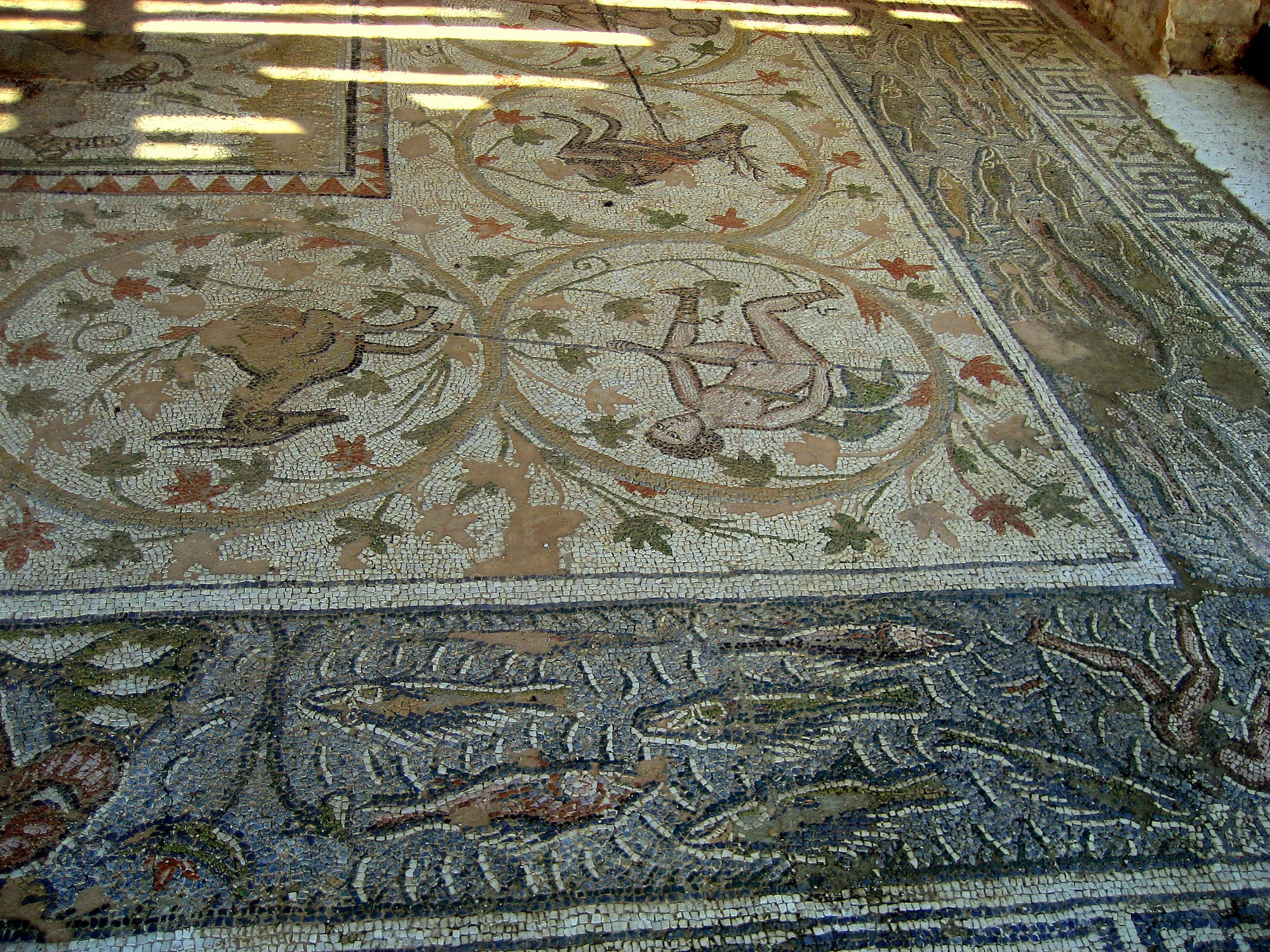
The early Christian mosaics (€550,000, Recovery and Resilience Facility). A separate project conserved the mosaics at Basilica A, the church associated with Bishop Dometios, and at a second basilica. TOVIMA calls the second "Basilica D"; the Greek City Times calls it "Basilica IV." An accessible route was also created around the second basilica. Basilica A's floors, both outlets agree, feature plant and animal motifs, hunting scenes, and marine subjects.
The road bypass. Planned, funded, and implemented by the Region of Epirus, the bypass removed the national highway from the archaeological site. Mendoni thanked Regional Governor Alexandros Kachrimanis by name. This is a genuine infrastructure win for the site's integrity, and the ministry is right to credit it.
What is still happening
Phase 3 of the Great Theatre entered the NSRF 2021–2027 programme on 8 April 2026, with a budget of €3.5 million. The scope, as listed by both TOVIMA and the Greek City Times, includes: restoration of the stage building and backstage areas (paraskenia); restoration of the orchestra; completion of the seating; accessibility infrastructure for people with disabilities; a drainage system; and completion of archaeological excavation, conservation, and documentation work. The ministry's briefing adds that the seating work involves 167 new seat supports, bringing each wedge-shaped section of seating (kerkís) to five rows.
It also specifies that the new elements will be made of compatible limestone, installed using reversible techniques, and made distinguishable from the original material. That is good conservation practice. It is also, by definition, work that has not yet been done.
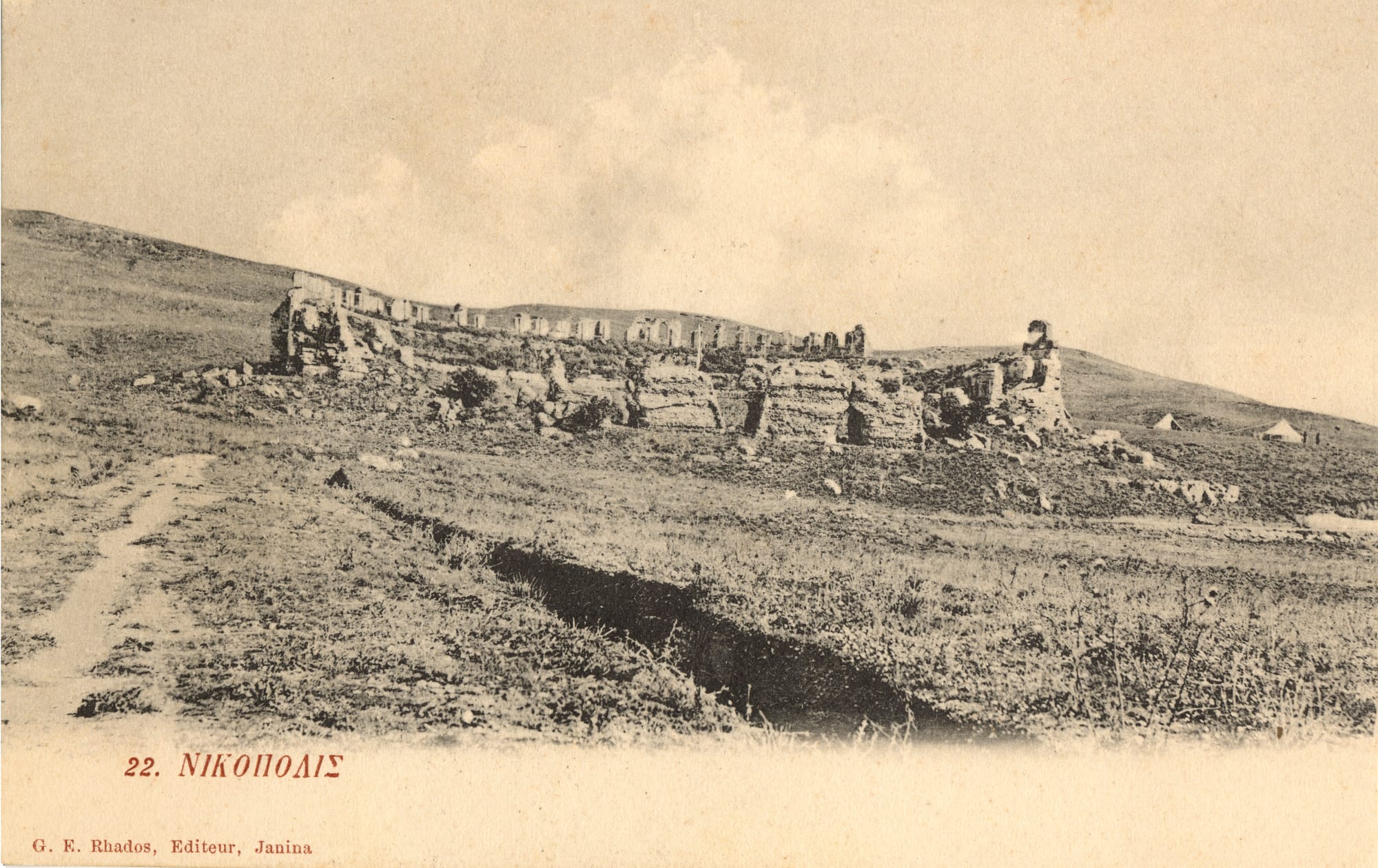
The theatre's initial construction dates to the Augustan period; it underwent extensive reconstruction in the second century AD. TOVIMA and the Greek City Times both report it could accommodate approximately 8,000 spectators. Most of the original stone seats were removed in later periods, reused as building material or for lime production. Three lime kilns, recorded by the British architect Thomas Leverton Donaldson in the early nineteenth century, are the evidence. Today, only parts of the first three rows of the lower cavea survive, along with one seat support in the eleventh row and scattered fallen seats.
That is the state of the monument the ministry is presenting to the world. Parts of three rows. One seat support in the eleventh row. A stage building on temporary props.
The UNESCO bid and the politics of it
Mendoni's remarks at the inauguration, as reported by TOVIMA, are where the institutional framing gets most explicit.
"The inclusion of Nicopolis on the UNESCO World Heritage List is a goal of national importance," she said. "With cooperation, consistency and dedication, we are all working so that this unique heritage can receive the international recognition it deserves."
She also warned that attempts to claim early "ownership" of the candidacy could create problems in a process requiring unity and a shared effort.
The preliminary dossier has been submitted. The process, as Mendoni herself put it, is "demanding and lengthy."
Mendoni also described Nicopolis as preserved within a largely unspoiled natural landscape protected under the Natura 2000 network and the Ramsar Convention.
The political context she invoked: in seven years of the Mitsotakis government, Greece submitted three UNESCO candidacies — the Zagori cultural landscape, the Minoan Palatial Centres of Crete, and Mount Olympus — and all three were inscribed.
"We are working with the same dedication for Nicopolis," Mendoni said. Mendoni's framing — the national goal, the ownership warning, the emphasis on unity — is a political frame, not just a description of a conservation process.
The founding, for the record
Nicopolis was founded by Octavian Augustus following his victory at the Battle of Actium in 31 BC over Mark Antony and Cleopatra VII. The city developed into an administrative, commercial, and military centre, drawing population from Epirus, Aetolia-Acarnania, Lefkada, and Roman settlers. From the third century AD onward it declined under the crisis of the Roman Empire and barbarian raids. Under Diocletian it was designated the capital of the province of Epirus Vetus. In the mid-sixth century, Justinian I renovated its walls. The Apostle Paul preached in the city in AD 62–63. From the fifth century onward it became a powerful ecclesiastical centre, with a metropolitan see under the jurisdiction of the Patriarchate of Rome until AD 732/733.
None of this is in dispute. The founding, the decline, the Christian transformation — the historical record is solid.
The verdict
The ministry has done real work at Nicopolis. The 36 new rooms in the Ekdikos house are a genuine archaeological gain, the mosaics are conserved, and the Region's bypass has taken the highway out of the site.
But the Great Theatre is not finished, as the ministry's own briefing makes clear.
It is a phased project, and the theatre's funded next phase is the part the language of closure does not cover.
The case file is open. Phase 3 is funded; the seats and the orchestra floor are still to come.
That is the part of the story still to come.
Sources
Greek Ministry of Culture (2026) 'The lower cavea of the Great Theater of Ancient Nicopolis is being restored', Days of Art in Greece, 26 August 2026, available at: https://daysofart.gr/en/news/from-ministry/the-lower-cavea-of-the-great-theater-of-ancient-nicopolis-is-being-restored/ (Accessed: 3 October 2026).
Greek City Times (2026) 'Greece Highlights Transformation of Ancient Nicopolis Site', Greek City Times, 29 September 2026, available at: https://greekcitytimes.com/2026/09/29/greece-highlights-transformation-of-ancient-nicopolis-site/ (Accessed: 3 October 2026).
Greek City Times (2026) 'UPDATE: President Tasoulas opens restored Nicopolis as UNESCO file moves forward', Greek City Times, 1 October 2026, available at: https://greekcitytimes.com/2026/10/01/update-president-tasoulas-opens-restored-nicopolis-as-unesco-file-moves-forward/ (Accessed: 3 October 2026).
TOVIMA (2026) 'Ancient Nicopolis Restoration Advances UNESCO Bid', TOVIMA, 1 October 2026, available at: https://www.tovima.com/culture/ancient-nicopolis-restoration-advances-unesco-bid/ (Accessed: 3 October 2026).