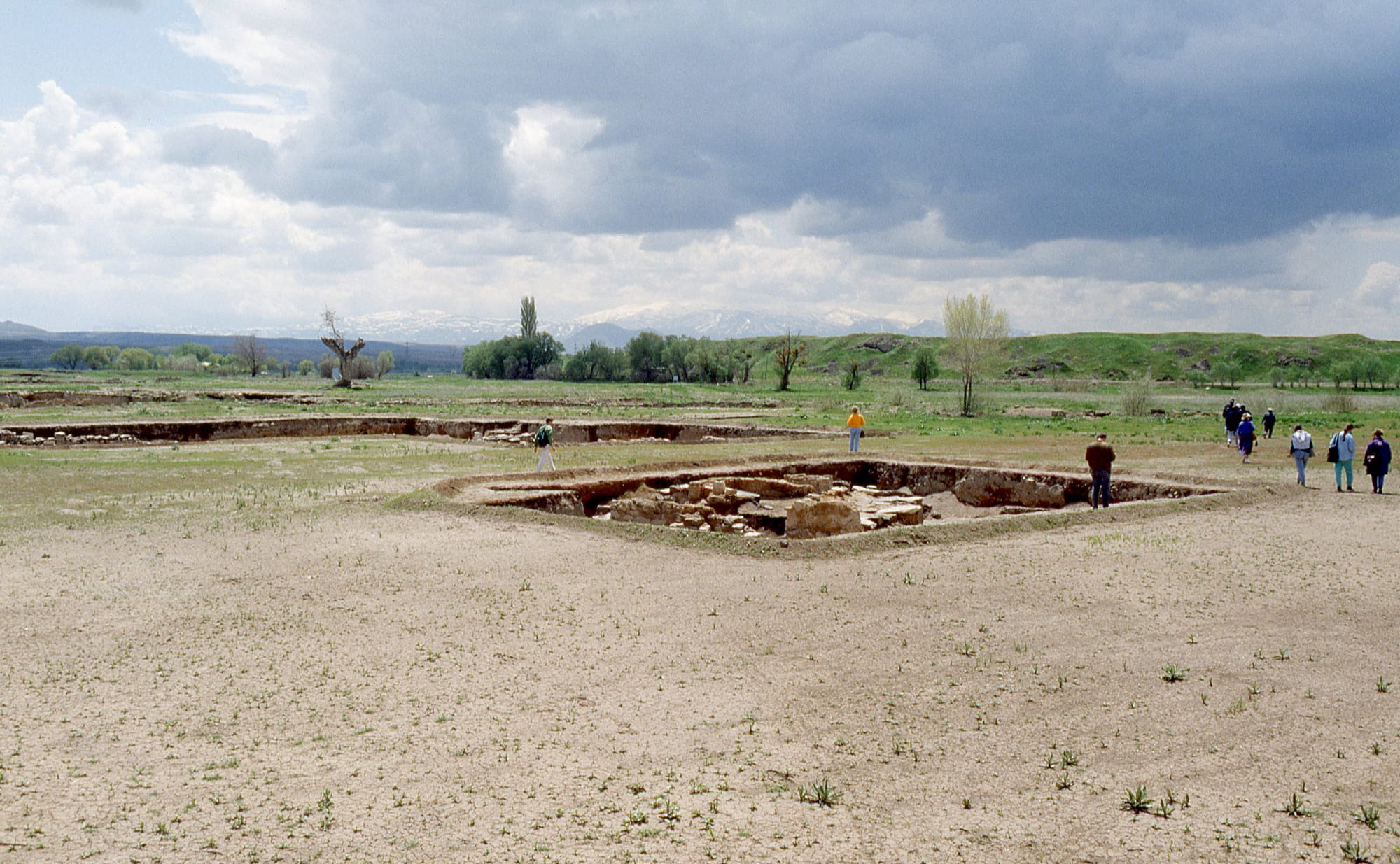
At Kültepe-Kaniş, the Hellenistic period has received less archaeological attention than the site's Bronze Age history. On 20 October 2026, Türkiye's Culture and Tourism Minister Mehmet Nuri Ersoy announced a find from that period: a mosaic-floored structure of the Hellenistic era, dug up in Kayseri province, central Türkiye.
What was announced
In a post on X, Ersoy called it a first in Kültepe's 78-year excavation history. He said the team had brought to light a Hellenistic-period mosaic-floored structure for the first time, and had also identified four separate Hellenistic cultural layers in the same area.
Türkiye Today reported that the structure is more than 2,000 years old. Daily Sabah, citing a ministry statement, dated it to the Hellenistic period (323–30 B.C.).
The mosaic
Daily Sabah gave the surviving section of the mosaic as 163 centimetres east to west and 165 centimetres north to south. Türkiye Today put it at about 1.6 metres on each side. Both outlets said fragments found around the structure suggest the original floor covered a larger area; Daily Sabah said a much larger one.
The two outlets described the construction in the same terms. The ground was levelled, then given a base of crushed stone and fine soil. A layer of small river pebbles went on top, and the flooring also incorporated ceramic fragments, lime and other materials.
The mosaic lies east of the Warşama (Warsama) Palace, where Turkish and South Korean researchers began working together in 2025.
Four layers
The four Hellenistic cultural layers are a significant part of the find. Daily Sabah reported that they were identified at the site for the first time. It said the team hopes that studying the artefacts from each layer alongside the architecture will give a clearer picture of Kültepe's Hellenistic history. According to Daily Sabah, previous excavations and studies gave that period less attention than the Bronze Age.
Ersoy's post said the layers shed light on lesser-known periods of the site. Daily Sabah translated that line as: "The four distinct Hellenistic cultural layers we identified in the same area are also shedding light on the lesser-known periods of this ancient Anatolian center."
That a Hellenistic mosaic is a first after 78 years of digging tells you where the spade has mostly gone. It also shows how much of a famous site can sit in the background of its own story.
Who is digging
This was the second season of a joint project. Türkiye Today named the partners as Türkiye's Ministry of Culture and Tourism, Ankara University and South Korea's National Research Institute of Cultural Heritage. Daily Sabah, citing the ministry, said the cooperation rests on a memorandum of understanding. Aktüel Arkeoloji, citing the ministry as its source, said the excavations are led by Prof. Fikri Kulakoğlu of Ankara University.
Ersoy called the find a valuable result of scientific and cultural cooperation between Türkiye and South Korea. He congratulated Kulakoğlu and the joint team and thanked the South Korean partners. "We continue to bring Anatolia's rich heritage to light through scientific research," Ersoy wrote, in Türkiye Today's translation of his post.
The site around it
According to Türkiye Today and Daily Sabah, Kültepe-Kaniş was inhabited from the third millennium B.C. into the Roman period. Before the rise of the Hittite Empire it was the capital of the Kingdom of Kaniş (also known as Kanesh). Its upper city held royal palaces and temples, and its lower city a karum, a trading quarter.
Both outlets say about 23,500 cuneiform tablets found at the site are listed on UNESCO's Memory of the World Register; Türkiye Today says they document the activities of Old Assyrian and Anatolian merchants. They also say the site was added to UNESCO's World Heritage Tentative List in 2014, and that only about 5% of its area has been excavated.
What comes next
Türkiye Today and Daily Sabah both report that, after the Hellenistic layers, the project plans research in deeper deposits containing remains from the Kingdom of Kaniş through the Hittite period.
Sources
Aktüel Arkeoloji (2026) 'Kültepe'de Bir İlk! Hellenistik Dönem Mozaik Tabanlı Yapı Bulundu', Aktüel Arkeoloji, 20 October 2026, available at: https://aktuelarkeoloji.com.tr/kategori/guncel-kazilar/kultepe-de-bir-ilk-hellenistik-donem-mozaik-tabanli-yapi-bulundu (Accessed: 21 October 2026).
Daily Sabah with AA (2026) 'Archaeologists uncover 2,000-year-old mosaic in central Türkiye', Daily Sabah, 20 October 2026, available at: https://www.dailysabah.com/life/history/archaeologists-uncover-2000-year-old-mosaic-in-central-turkiye (Accessed: 21 October 2026).
Ersoy, M.N. (2026) 'Kültepe'de 78 yıllık kazı tarihinde bir ilk!', X, 20 October 2026, available at: https://x.com/MehmetNuriErsoy/status/2112469044951396477 (Accessed: 21 October 2026).
Türkiye Today Newsroom (2026) 'Türkiye's Kultepe reveals 2,000-year-old mosaic in archaeological first', Türkiye Today, 20 October 2026, available at: https://www.turkiyetoday.com/culture/turkiyes-kultepe-reveals-2000-year-old-mosaic-in-archaeological-first-3230693 (Accessed: 21 October 2026).
Picture credits
- Top picture: Trenches and mound at Kültepe-Kaniş, Kayseri province, photographed in 1993. Photo: Mark Landon, CC BY 4.0, via Wikimedia Commons
