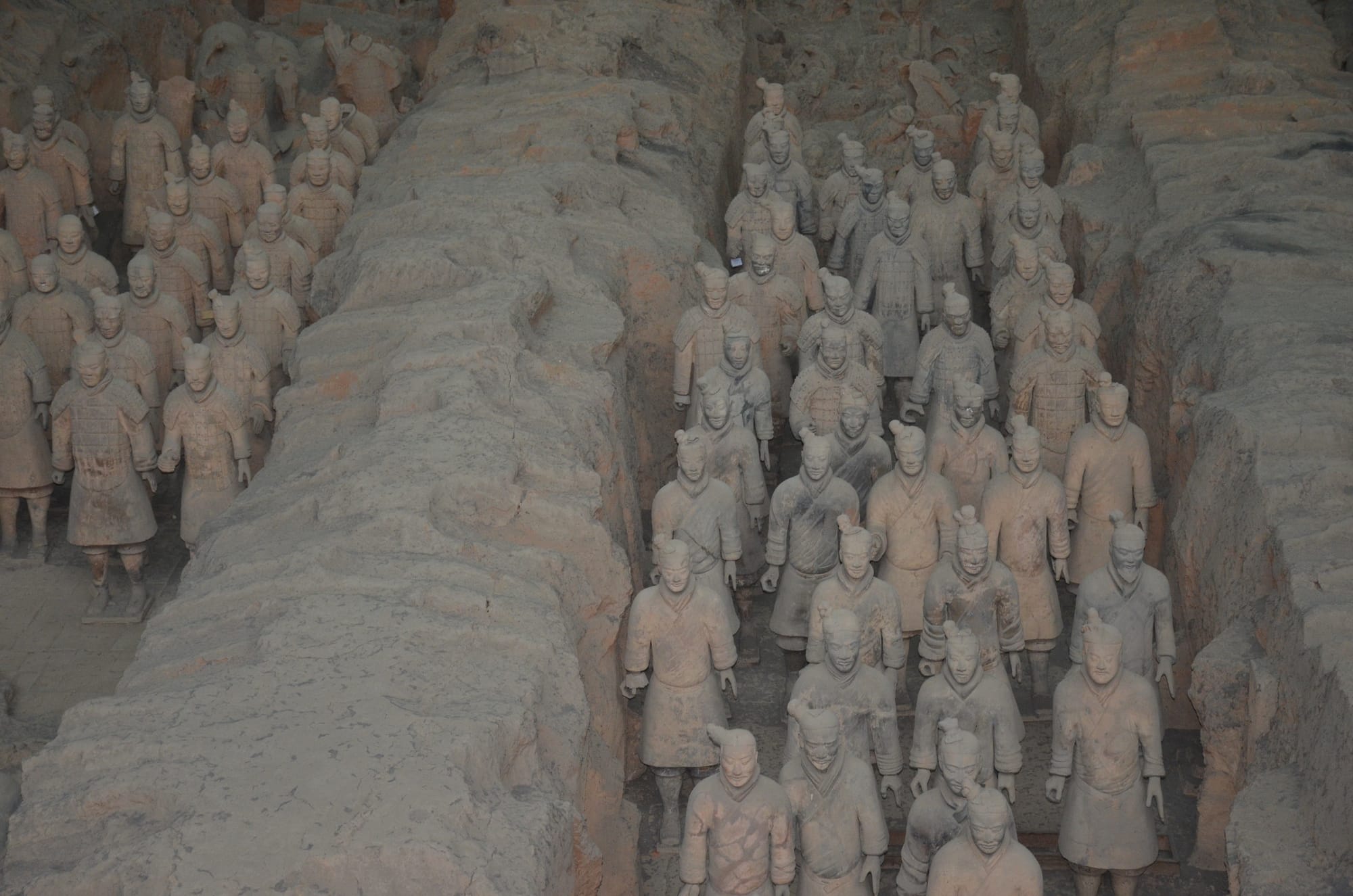
On 12 October 2016 the BBC ran a story headlined "Western contact with China began long before Marco Polo, experts say". Among its claims was that the inspiration for the Terracotta Warriors, buried near the tomb of the First Emperor, Qin Shi Huang, may have come from ancient Greece. Within days the archaeologist at the centre of it was telling a Chinese state news agency that the BBC had quoted her out of context and overstated her remarks.
This is a story about a claim, how it was built, and how fast it came apart in public.
What the BBC reported
The BBC quoted Li Xiuzhen, a senior archaeologist at the Emperor Qin Shi Huang's Mausoleum Site Museum. She said: "We now think the Terracotta Army, the Acrobats and the bronze sculptures found on site have been inspired by ancient Greek sculptures and art." The BBC said earlier Chinese statues were simple figurines about 20cm tall, and that no tradition of life-sized human statues existed before the tomb. It presented Li as believing outside influence must explain the jump.
It then quoted Prof Lukas Nickel of the University of Vienna, who said statues of acrobats found at the tomb support the theory. The BBC quoted him: "I imagine that a Greek sculptor may have been at the site to train the locals." The BBC added that a separate study had found European-specific mitochondrial DNA at sites in Xinjiang. It said this suggested Westerners may have settled, lived and died there before and during the First Emperor's time.
Smithsonian Magazine covered the story on 14 October, citing The Independent and National Geographic. Its subhead read: "New analysis and DNA evidence suggests the 8,000 life-sized figures in emperor Qin Shi Huang’s necropolis owe their inspiration to the Greeks". The BBC had called the DNA work a separate study.
The paper underneath
The idea was not new in 2016. Nickel published "The First Emperor and sculpture in China" in the Bulletin of SOAS in October 2013, when his affiliation was SOAS, University of London. Its abstract says sculpture was widely used in Greece and the Hellenistic East but played only a minor role in ancient East Asia. It says that changed with the First Emperor, who marked his ascent to the throne in 221 BC with giant bronze sculptures outside his palace and thousands of terracotta figures in his tomb. The abstract describes the paper as joining art-historical, archaeological and textual evidence to investigate "whether the First Emperor's extraordinary interest in sculpture may have been the result of contacts with the contemporary Hellenistic world."
NBC News carried Owen Jarus's report on the paper in December 2013. Jarus quoted Nickel as writing: "It is perfectly possible and actually likely that the sculptures of the First Emperor are the result of early contact between Greece and China." The report set out two strands of his case:
- The giants. As NBC reported it, Nickel translated ancient Chinese records of 12 giant statues, clad in "foreign robes", that "appeared" in Lintao, in what was then the westernmost part of China (NBC notes the name can also mean any place far to the west). NBC says the records do not explain how they got there, who brought them or whom they depicted. They give the statues' height as about 38 feet (11.55 metres). The First Emperor was so struck, the records say, that he melted down bronze weapons to make 12 duplicates in front of his palace. Those duplicates no longer exist.
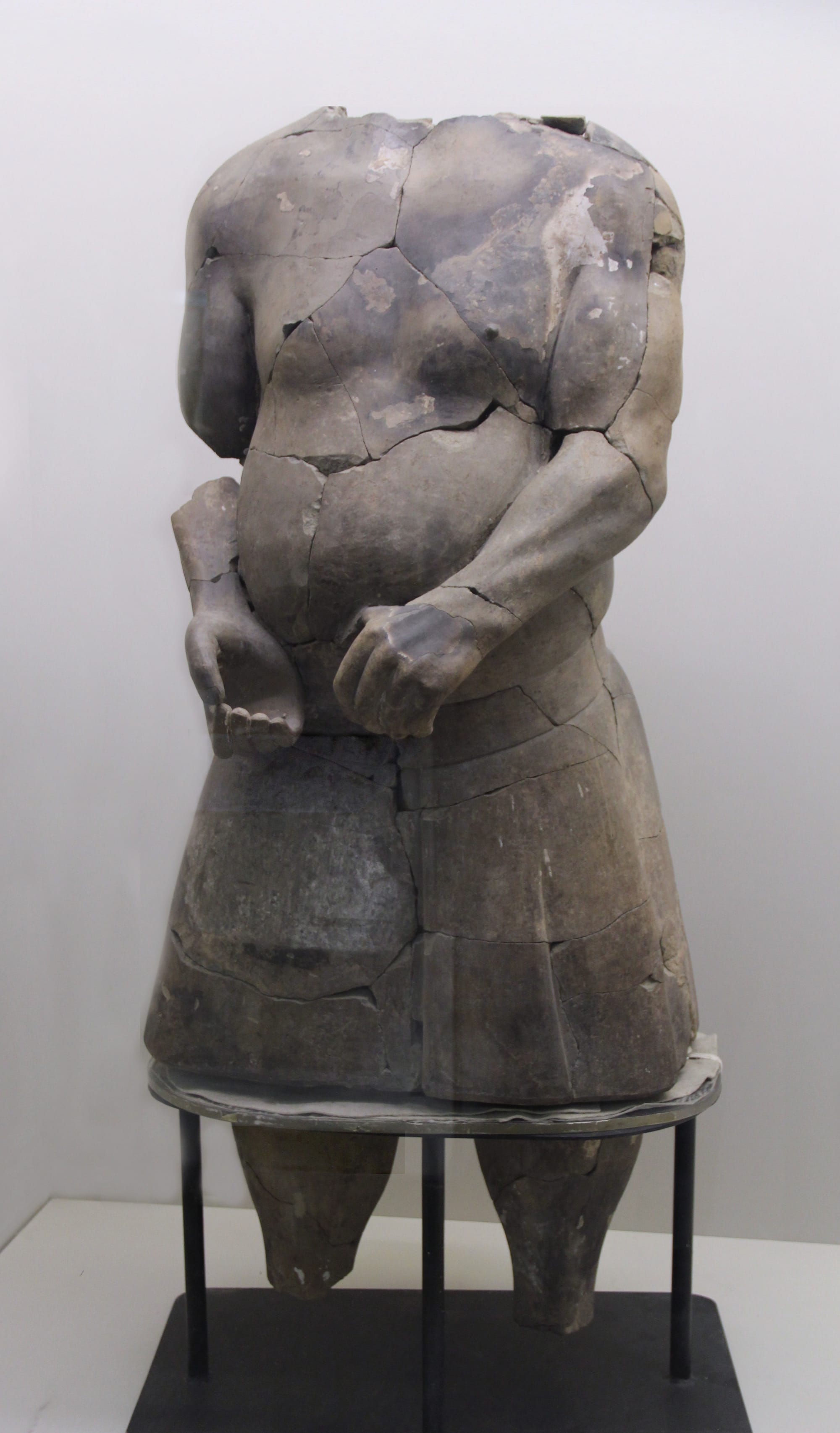
- The acrobats. A few dozen statues of half-naked acrobats and dancers were found in separate pits near the mausoleum. Nickel wrote that their sculptors "attempted to render a bone structure, muscles and sinews to depict a person in movement."
Li Xiuzhen's reply
On 18 October 2016 Xinhua reported that Li had refuted the BBC piece, saying it quoted her out of context and overstated her remarks about Western influence. She told Xinhua: "I think the terracotta warriors may be inspired by Western culture, but were uniquely made by the Chinese." Xinhua reported her saying that local soil, craftsmen and traditional funeral culture all contributed. She also objected that the BBC had placed her quotes right before Nickel's, though his opinion, she said, was contrary to hers. She added: "I am an archaeologist, and I value evidence. I've found no Greek names on the backs of Terracotta Warriors, which supports my idea that there was no Greek artisan training the local sculptors."
The Conversation reported that, two weeks after the story broke, Zhang Weixing, whom it described as head of the same site museum, told AFP there was "no substantial evidence at all" for contact between ancient Greeks and those responsible for the Qin tombs.
The Eurocentrism charge
The Conversation article argued that the Greek-influence reading rests on a long habit of assuming other civilisations could not have produced sophisticated art unaided. Its authors, two Brown University academics, gave examples: the notion of Greco-Buddhist art, which they say art historian Michael Falser has shown to be a colonial idea from British rule in India, and the German explorer Karl Mauch, who reached Great Zimbabwe in 1871 and credited it to the Queen of Sheba.
Where this leaves the case
My reading is that the claim and the evidence came apart in the retelling. Nickel's argument, as NBC reported it, includes a textual story about foreign-robed giants and how the acrobats were modelled, set against the spread of Greek-influenced sculpture in Central Asia after Alexander, and it was published in a journal. A Greek sculptor training locals on site is the part he framed with "I imagine". Li's own account, as Xinhua gave it, allows Western inspiration but not a Greek trainer.
On Li's own account, the BBC's claim of Greek inspiration ran ahead of what the one named archaeologist it leaned on meant, and she said so within a week. The Lintao records and the acrobats remain part of Nickel's case for contact, and the Greek sculptor on site remains his speculation.
Sources
BBC News (2016) 'Western contact with China began long before Marco Polo, experts say', BBC News, 12 October 2016, available at: https://www.bbc.com/news/world-asia-china-37624943 (Accessed: 26 October 2026).
Daley, J. (2016) 'Did the Greeks Help Sculpt China's Terra Cotta Warriors?', Smithsonian Magazine, 14 October 2016, available at: https://www.smithsonianmag.com/smart-news/did-greeks-help-sculpt-chinas-terracotta-warriors-180960771/ (Accessed: 26 October 2026).
Jarus, O. (2013) 'China's Terracotta Warriors inspired by ancient Greek art', NBC News, 11 December 2013, available at: https://www.nbcnews.com/sciencemain/chinas-terracotta-warriors-inspired-ancient-greek-art-2d11727052 (Accessed: 26 October 2026).
Nickel, L. (2013) 'The First Emperor and sculpture in China', Bulletin of SOAS, Cambridge University Press, 76(3), pp. 413–447, published online 9 October 2013, doi: 10.1017/S0041977X13000487, available at: https://www.cambridge.org/core/journals/bulletin-of-the-school-of-oriental-and-african-studies/article/abs/first-emperor-and-sculpture-in-china/41FA075D1EAC96A61BD5B72DEE0B7FF4 (Accessed: 26 October 2026).
Hanink, J. and Rojas Silva, F. (2016) 'Why there's so much backlash to the theory that Greek art inspired China's Terracotta Army', The Conversation, 18 November 2016, available at: https://theconversation.com/why-theres-so-much-backlash-to-the-theory-that-greek-art-inspired-chinas-terracotta-army-67488 (Accessed: 26 October 2026).
Xinhua (2016) 'Chinese archaeologist refutes BBC report on Terracotta Warriors', Xinhuanet, 18 October 2016, available at: https://www.xinhuanet.com/english/2016-10/18/c_135763397.htm (Accessed: 26 October 2026).
Picture credits
- Top picture: Terracotta warriors from the First Emperor's burial complex. Rows of terracotta warriors in the pits, photo by shankar s. (CC BY 2.0, Wikimedia Commons)
- A terracotta figure from the First Emperor's burial complex. Photo: Gary Todd (source)

