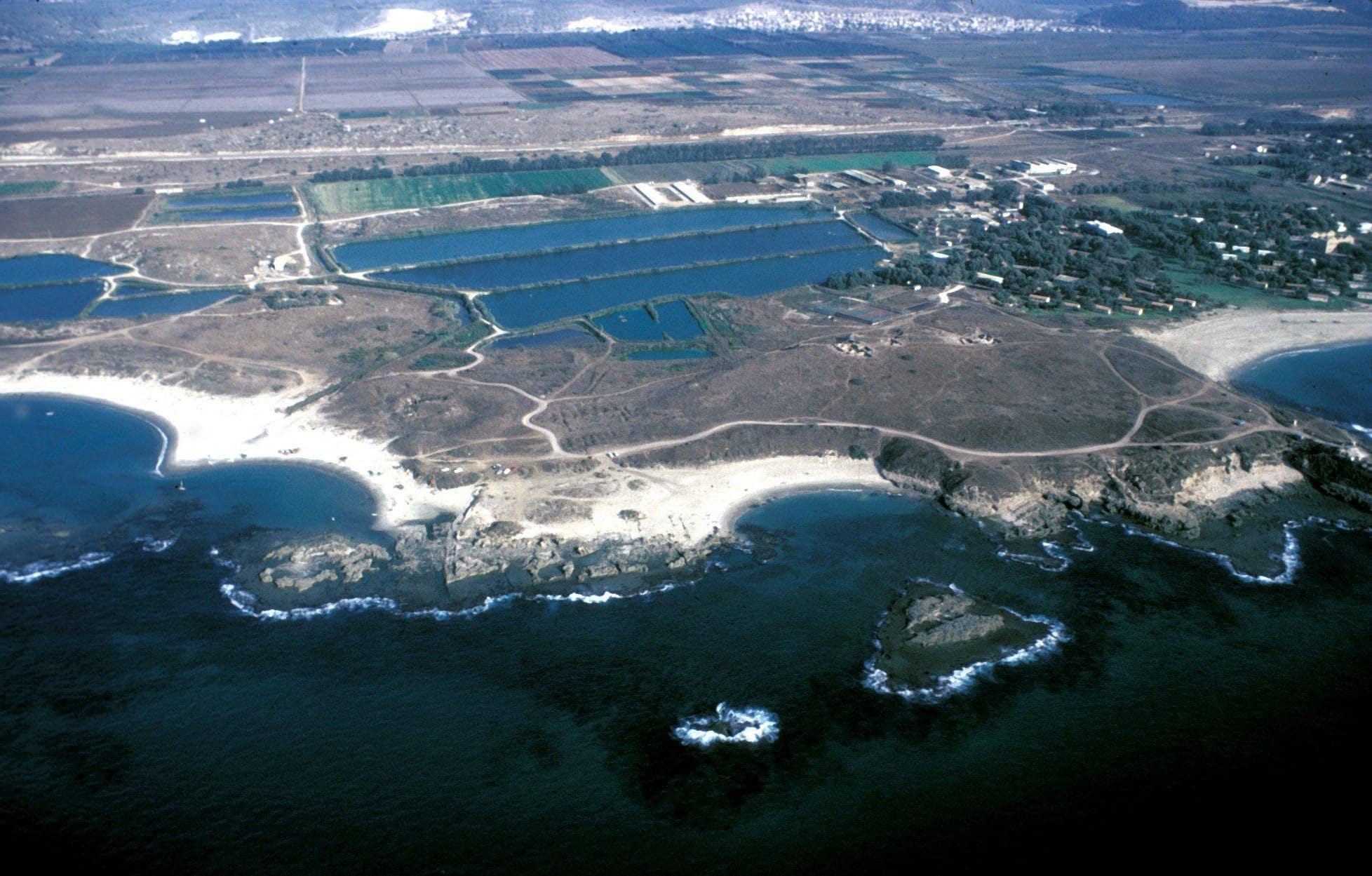
For a quarter of a century or so, a very large piece of ancient anchor sat in Israel's Dor Lagoon under sandbags, dated to the wrong period. A study published on 20 October 2026 in the Journal of Maritime Archaeology puts it much earlier. It belongs, the authors say, to a ship cargo of the late 7th or early 6th century BCE, which makes it one of the earliest wood-and-lead anchor stocks known from the Mediterranean.
What was found
The object is the stock of an anchor: the crosspiece, not the whole device. It is a rectangular oak timber with four lead cores set into it. Its conserved length is 2.1 metres and its original length was about 2.2 metres, with a width of 16 cm and a thickness of 10 cm. The authors call it "the largest eastern Mediterranean wood and lead anchor stock found to date".
It was first found in 1994–1995 by a joint University of Haifa and Texas A&M University project. It was documented in 1997 and initially dated to the Persian period. An earlier publication, from 1996, had put the find in the 6th to 4th centuries BCE. The anchor and the pottery around it were left where they lay and covered with sandbags.
How the date moved
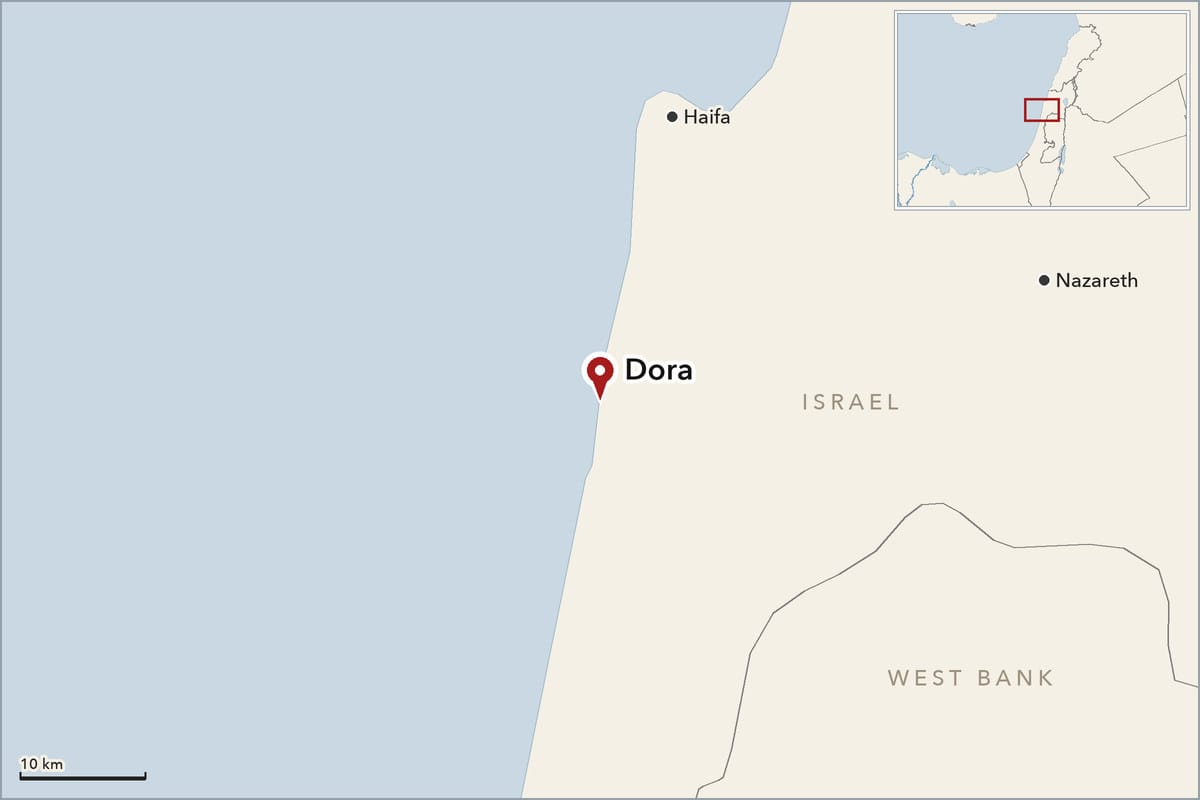
The Dor Lagoon is the southernmost of the bays around Tel Dor, which the paper places 21 km south of Haifa. The paper describes the site as providing one of the best anchorages between Egypt and the Phoenician coast.
The authors report that recent excavations by the University of Haifa and the University of California, San Diego, relocated the stock. They dug around it and found it was not an isolated object. The stock lay beside the main concentration of pottery and iron blooms, surrounded by sherds of basket-handled amphorae. The cargo, designated Dor L2, comprised:
- at least fifteen basket-handled amphorae
- four Phoenician-type amphorae
- three thin-walled bowls
- nine iron blooms, weighing 69.75 kg in total
- ballast stones
The cargo was dated by radiocarbon on short-lived samples: grape pits and two resin samples from different amphorae, and an oak twig found inside one of the iron blooms. Modelling of the vessel's last voyage gives a range ending in the mid-sixth century BCE, all before 536 BCE, with a median of 639–631 BCE.
The anchor's own sample is looser. Its 2σ range is 770–485 BCE, with a 93.1% probability of falling between 770 and 513 BCE. The authors read it as matching the cargo's date, and they add that the chronology of the basket-handled amphorae also supports the date. That is the logic of the redating: the modelled dates from the cargo's short-lived samples and the anchor's wider range agree.
How it was built
Carpenters cut four trapezoidal cavities into the oak with a chisel and an adze, and molten lead went into them. The trapezoid shape lets each core sit in the wood without slipping out.
The stock also has eight small, nearly square slots, four on each side. According to the paper, residual lead poured into them formed a "casting bolt" holding each core in place. A locking mechanism like this had been suggested for the lead cores from the Tektaş Burnu shipwreck, which are dated to 450–425 BCE. No wood survived with those cores. The authors say the Dor find supports that suggested reconstruction. They also note that casting bolts do not appear in examples of the fourth century BCE and later, and say they may be a chronological indicator.
The stock has a tongue-and-groove joint where it met the shank. The paper calls it "the only example of such a complex joint in a wooden composite anchor". Recesses on its sides show it belonged to a two-armed anchor. The shanks, arms and the arms' teeth are missing.
The lead figures are estimates. Four cores of about 28.3 kg each give roughly 113 kg of lead and a total stock weight of about 150 kg, calculated from 3D models and a wood sample, assuming pure lead. The authors note that some impurities may be present. The stock was too fragile to move and was never turned over, so its underside is inferred from comparative data, the wood sample, the 3D measurements and experiments with lead pouring on a scaled-down model.
Where it sits in the wider picture
The authors set the stock against other dated finds. Its date makes it roughly contemporary with the Mazarrón 2 boat in Spain, which was 8.15 m long, and with anchors from Karaburun, Turkey. The two Karaburun anchors presumably carried stone stocks estimated at 200–240 kg, heavier than Dor's roughly 150 kg. Their radiocarbon ranges are wide: 775–515 BCE and 751–408 BCE. At Liman Tepe, a wooden anchor shank-arm timber dates to the decades before or after 600 BCE. At Pabuç Burnu, a stone stock dates to the second quarter of the sixth century BCE.
From this, the paper argues for a gradual change rather than a clean swap. There seems, the authors say, to have been an overlap of around a century in which both stone-stock and wood-and-lead anchors were in use. Stone stocks continued into the fifth century BCE but not later, and wood-and-lead stocks continued until the third century BCE. The stock's size hints at a larger vessel than Mazarrón 2 or the 14.5 m Ma'agan Mikhael ship, but the authors say further excavation and perhaps the ship's timbers are needed to say more.
Coins from Apollonia Pontica show scholars disagreeing. Haldane suggested the anchors on them are stone-stocked, while Kapitän argued they are wood-and-lead. The paper suggests the earlier coins show curved, crescent-shaped stocks and the later ones, from the second half of the fifth century BCE, rectangular ones. The paper itself frames this cautiously, opening with the words "it may be possible to see" the transition in the coins.
A view
The paper says the original typology of these anchors was built about 40 years ago on the finds then available, none of which preserved wooden parts apart from the Ma'agan Mikhael anchor, and that left basic questions open. A find that sat on the seabed, documented and covered over, was redated once someone dug the cargo beside it. The chronology of composite anchors is now being rewritten from the bottom of a lagoon, one dated cargo at a time.
Sources
Arkeonews (2026) '2,600-Year-Old Giant Lead-Filled Anchor Among the Oldest Ever Discovered', Arkeonews, by Leman Altuntaş, 20 October 2026, available at: https://arkeonews.net/2600-year-old-giant-lead-filled-anchor-among-the-oldest-ever-discovered/ (Accessed: 21 October 2026).
Johnson, K. et al. (2026) 'Stone to Lead: The Anchor from the Dor L2 Cargo and the Chronology of Composite Anchors from the 7th‒4th Centuries BCE', Journal of Maritime Archaeology, 21, article 53, 20 October 2026, available at: https://link.springer.com/article/10.1007/s11457-026-09542-1 (Accessed: 21 October 2026).
Picture credits
- Top picture. Image: Tel Dor shoreline (aerial, c.1982): Moshe Anbar / University of Haifa Digital Media Center, CC BY 2.5 (source)
- Map: drawn from Natural Earth (public domain) and Wikidata.
