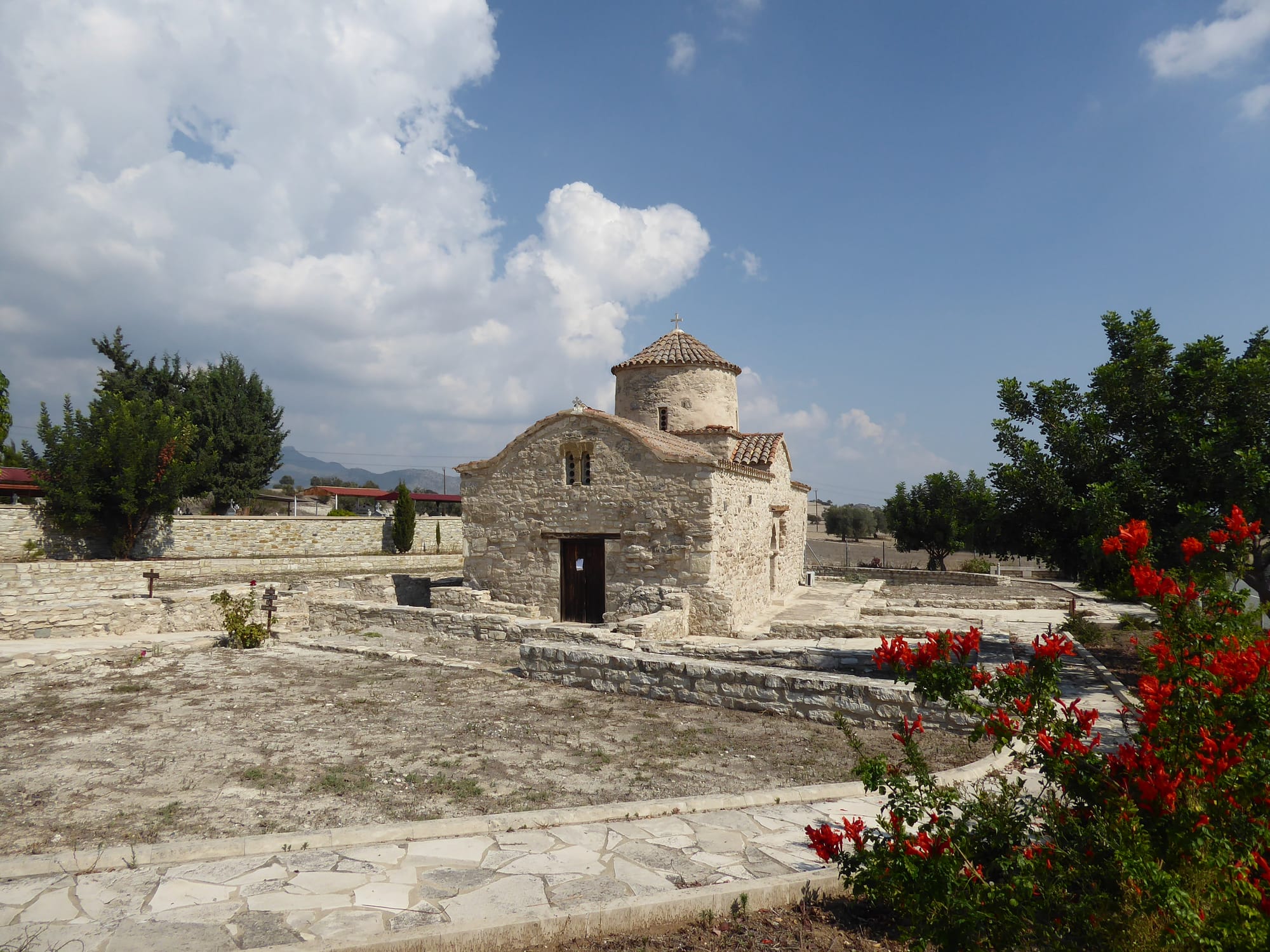
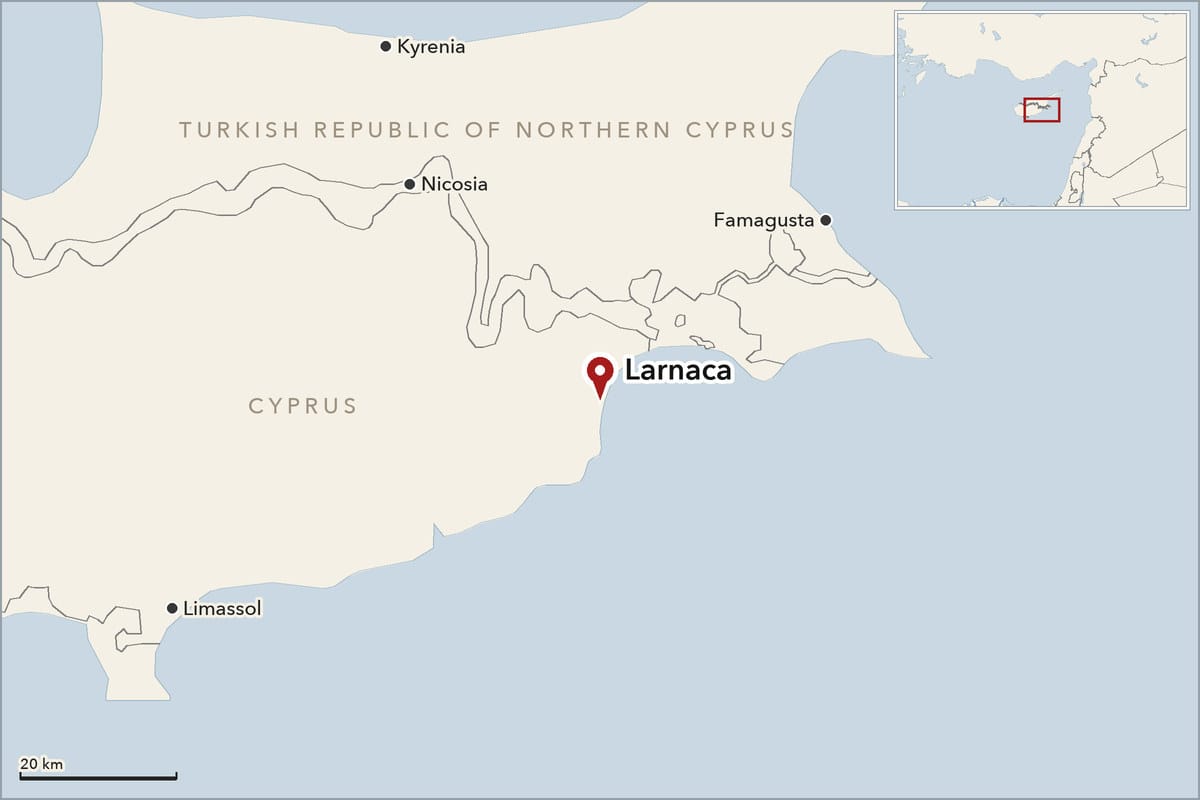
Two excavations in the Larnaca district of Cyprus have produced a Byzantine church and a clay-processing tank, according to the island's Department of Antiquities. The department announced the results on Monday 26 October 2026. The digs were at Kofinou-Ayios Heraklios and Menoyia-Limnes and were run by the University of Cyprus between 15 June and 24 July, through the field project of its archaeological research unit and the summer field school of its Department of History and Archaeology.
The church speaks to burial and worship across several centuries. The tank, the department says, is the first direct archaeological evidence in Cyprus for part of the production process in a pre-modern pottery workshop.
The church at Kofinou-Ayios Heraklios
The department described the structure, partly exposed before this season, as a compact six-column cross-in-square church built between the 8th and 10th centuries AD. This season's work uncovered a near-complete floor of large gypsum slabs. Strips of lime mortar on the floor mark where the templon, the sanctuary screen, stood.
Cyprus Mail, quoting the department, lists a dome with curved voussoirs forming part of the dome's drum, and a square bay formed by the second and third pairs of pilasters. Fragments of non-figurative fresco turned up on the lower south wall. They resemble marble revetment, with red and green bands on a white background. In the sanctuary, a smaller secondary apse sits inside the larger apse of the original early Byzantine basilica.
Four phases, on preliminary dating
The department's preliminary dating proposes four successive phases:
- an early Byzantine three-aisled basilica, from the late 6th to the early 7th century;
- a domed cross-in-square church built over the basilica's central nave, from the 8th to the 10th century;
- funerary and domestic activity after the church collapsed, from the mid-14th to the mid-16th century;
- a small barrel-vaulted chapel of Ayios Heraklios, built over the middle section of the basilica's narthex after the 16th century.
Ceramics from the collapse layers date the church's abandonment and partial collapse to the mid-14th century. Hearths, cooking vessels and animal bones in the debris point to a non-liturgical use of the ruined space from the late 14th to the mid-16th century. A trench south-east of the church confirmed burials in the surrounding area in the Late Middle Ages, with scattered human bones, a grave slab and ceramics of the 15th and 16th centuries.
The department says this is the first time in Cyprus that an organised cemetery in continuous use from the 6th to the 16th century has been documented archaeologically, together with evidence of cult activity in the 8th to 10th centuries. Cyprus Mail carries its wording: it is "for the first time in Cyprus that an organised cemetery, in continuous use from the 6th to the 16th century, together with evidence for cult activity during the troubled 8th to 10th centuries, are being documented archaeologically". That "first" is the department's own claim.
The clay-processing tank at Menoyia-Limnes
At Menoyia-Limnes, five new trenches widened the picture of an early Byzantine pottery workshop. The department called the most outstanding discovery of the season a built clay-processing tank, constructed directly on the natural rock, with alternating layers of pure clay and sieved earth inside. In the department's words, as carried by Cyprus Mail, it provides "for the first time in Cyprus, direct archaeological evidence for part of the production process in a pre-modern pottery workshop".
A water channel made of two parallel rows of upright stones was found feeding into the basin, suggesting an organised production facility. The trenches also revealed:
- architectural remains of storage and working spaces;
- piles of wedged clay;
- a large storage pithos in situ;
- fragments of pottery wheels;
- abundant production waste, including wasters and over-fired sherds.
Why the department says it matters
The department said the 2026 season reinforces the importance of both sites for understanding rural and religious life, funerary customs and pottery production in Byzantine and medieval Cyprus. It also said the work continues to shed light on the so-called Dark Ages of Byzantine Cyprus, the 8th to 10th centuries, a period it describes as one that "remains largely invisible in the island’s archaeological record", in Cyprus Mail's report of its statement.
That period is the part of the story worth watching. A church built in the 8th to 10th centuries, a cemetery the department says ran from the 6th to the 16th century, and a workshop tank all come from one announcement. The dating of the church complex is described as preliminary, and the department's two "first in Cyprus" claims are its own. Cyprus Mail, Sigmalive and Cyprus Inform all report them as the department's statements.
Sources
Cyprus Inform Team (2026) 'Byzantine church and clay-processing tank uncovered in Larnaca district excavations', Cyprus Inform, 26 October 2026, available at: https://www.kiprinform.com/en/news/byzantine-church-and-clay-processing-tank-uncovered-in-larnaca-district-excavations/ (Accessed: 29 October 2026).
Cyprus Mail (2026) 'Byzantine church temple uncovered at Ayios Heraklios site', Cyprus Mail, 26 October 2026, available at: https://cyprus-mail.com/2026/10/26/byzantine-church-temple-uncovered-at-ayios-heraklios-site (Accessed: 29 October 2026).
SigmaLive English (2026) 'Byzantine church and pottery tank uncovered in Cyprus', Sigmalive English, 27 October 2026, available at: https://en.sigmalive.com/byzantine-church-and-pottery-tank-uncovered-in-cyprus/ (Accessed: 29 October 2026).
Picture credits
- Top picture: Church of Panagia Kofinou. Church of Panagia Kofinou, photo by Chris06 (CC BY-SA 4.0) (source)
- Larnaca, Cyprus. Photo: DanielMichaelPerry (CC0, Wikimedia Commons)
- Map: drawn from Natural Earth (public domain) and Wikidata.

