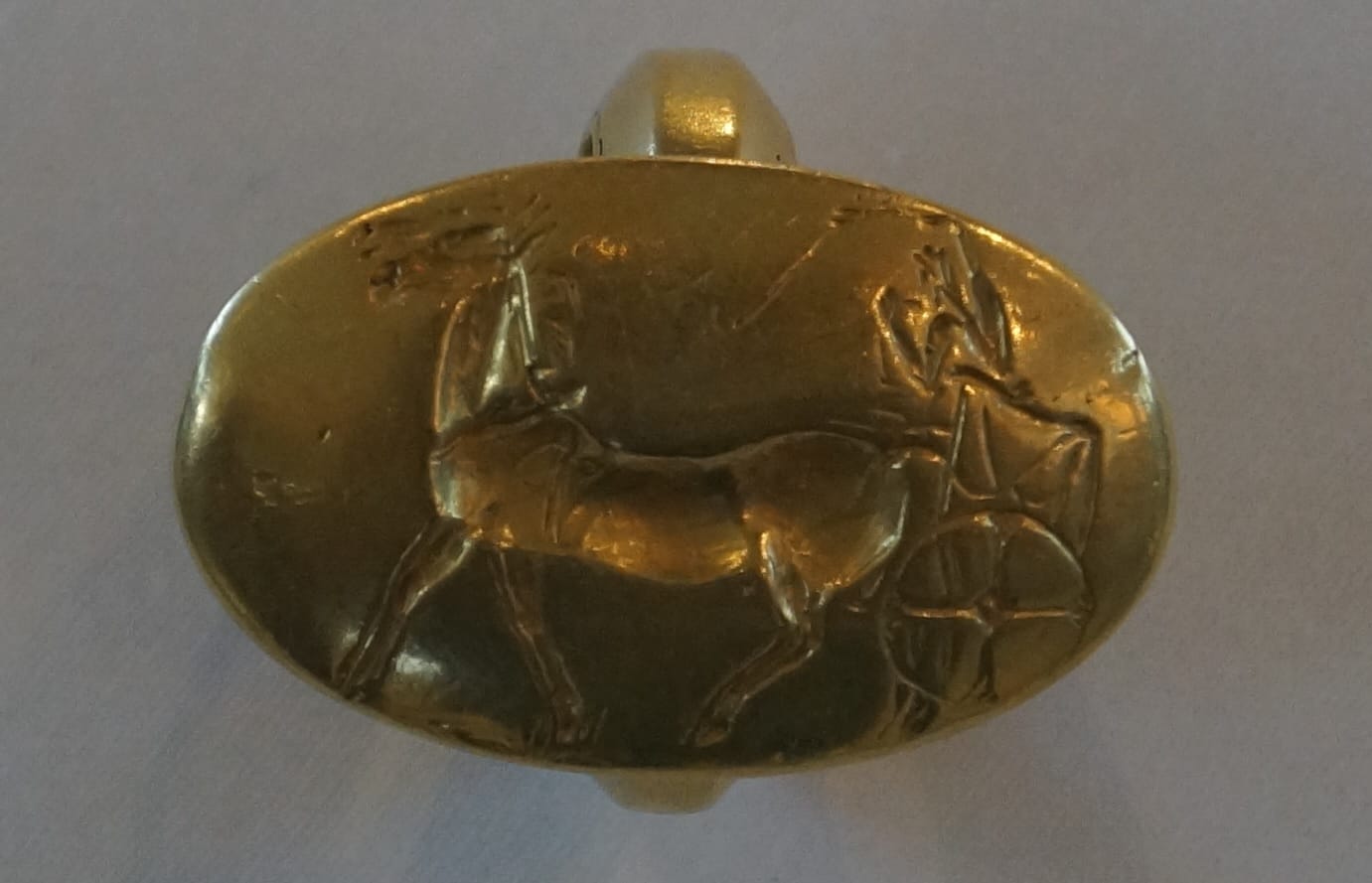
Chemical analysis of 91 ancient iron weapons and pieces of jewellery turned up traces of nickel in about a dozen signet rings, Science News reported on 7 August 2026. Nickel is a sign the iron probably came from meteorites, according to the researchers, who reported in the August 2026 Journal of Archaeological Science. The study is titled “Iron in Greece in the Second Millennium B.C.E.” and grew out of a five-year French–Greek collaboration.
How the rings were tested
The study was led by Matthieu Gounelle, whom Science News describes as an astrophysicist and chemist at the French Natural History Museum in Paris, and Eleni Mantzourani, a prehistoric archaeologist at the University of Athens. La Brújula Verde describes the team as visiting nineteen museums and thirty-three archaeological sites to answer a question that had gone unanswered for decades: did the Mycenaeans and Minoans use meteorite iron, as other Bronze Age cultures did? According to Knossos Palace, 105 objects from the Bronze Age and the Early Iron Age were examined, and 91 iron objects formed the core of the study, mainly rings, bracelets and knives. The same page says they date from roughly 1800 to 1000 BC.
The team used portable X-ray fluorescence, a technique that measures what an object is made of without damaging it. Meteorite iron carries plenty of nickel; iron smelted from ore does not. Science News reports the researchers as writing that the iron in meteorites typically contains a high proportion of nickel, sometimes up to 50 percent.
Only the rings carry the signature
Thirteen objects, all of them finger rings, contained significant amounts of nickel, according to La Brújula Verde's account of the paper. Of those thirteen, nine are very likely of meteoritic origin, one is quite likely, and three deserve further examination. Science News puts it as the researchers thinking 10 were probably made with meteoric iron, while the other three need more study.
Across the whole sample, 78 pieces, or 86%, contained no nickel; La Brújula Verde describes them as smelted, terrestrial iron. Although the sample also held tools and weapons, only rings turned out to be made of meteorite iron, according to Knossos Palace. That split between the rings and everything else is the detail that gives the study its interest.
Rings for the elite
Science News reports that the meteoric metal was often layered with gold and silver. Almost all the rings came from elite tombs, richly furnished tholos and chamber tombs, according to La Brújula Verde and Knossos Palace. Two rings, from Mycenae and Phaistos, have a bezel cut in two, with one half gold and the other nickel-bearing iron, finely engraved, according to Knossos Palace. The only ring not recovered from a tomb comes from the shrine at Anemospilia, on the slopes of Mount Juktas near Archanes, a few kilometres south of Knossos, the same page says. La Brújula Verde adds that it was found on the finger of a man whom archaeologists interpret as a high-ranking priest in a Minoan sanctuary.
Mantzourani told Science News that the finding “shows that meteoritic iron was considered a very precious metal used for producing objects of special value and for a high-status group of people,” probably elite Mycenaeans and Minoans. La Brújula Verde reports Gounelle and Mantzourani as speculating that the rings probably made from meteorites could have been symbols of power popular among prominent individuals, members of the Minoan and Mycenaean palatial elite.
Where did the metal come from?
Meteorites are scarce in Crete and Greece, and the researchers suggest the valuable metal was imported from Egypt, Science News reports, a sign of ancient trade between these regions. Science News notes that iron from meteorites was prized throughout the ancient world, especially in Egypt, where arid deserts preserve meteorites. La Brújula Verde points to the Gerzeh beads of 3200 BCE and the dagger of Tutankhamun of 1350 BCE as earlier Egyptian examples of meteoritic iron.
A fashion that ended
La Brújula Verde reports that the fashion for these rings began in Crete in the 17th century BCE and in the Peloponnese in the 16th, and ended approximately when the Mycenaean palaces were destroyed in the early 12th century BCE. Mantzourani told Science News that meteorite iron rings from after the 12th century B.C. are not found in the region, which indicates the fashion disappeared around the time of the Late Bronze Age collapse. Knossos Palace says the shift may reflect economic and political turmoil, lost links with Egypt, or simply changing taste. The wording matters: this is a list of possibilities, not a finding.
What remains open
According to La Brújula Verde, the researchers say they do not know exactly how fragments were extracted from the meteorites, though they compare the technique to one the Inuit in Greenland used with basalt rocks. They also cannot say with certainty how many different meteorites were used for the thirteen rings, given nickel contents from 1% to 50%, which suggests several distinct meteorites. Knossos Palace describes the study as documenting for the first time, with modern non-destructive methods, meteorite iron in Aegean finds that had been long suspected and never proven.
Sources
La Brújula Verde (2026) 'Power Objects in Royal Tombs: The Rings of the Mycenaean and Minoan Elite Were Forged with Meteorite Iron', La Brújula Verde, 10 July 2026, available at: https://www.labrujulaverde.com/en/2026/07/power-objects-in-royal-tombs-the-rings-of-the-mycenaean-and-minoan-elite-were-forged-with-meteorite-iron/ (Accessed: 8 November 2026).
Science News (2026) 'Ancient Greek rings may have been forged with iron from meteorites', Science News, 7 August 2026, available at: https://www.sciencenews.org/article/bronze-age-greek-rings-iron-meteorites (Accessed: 8 November 2026).
Zorbas, A. (2026) 'Meteorite Iron Rings: How the Minoan and Mycenaean Elite Wore Metal From the Sky', Knossos Palace, 21 August 2026, available at: https://knossos-palace.gr/2026/08/21/meteorite-iron-rings/ (Accessed: 8 November 2026).
Picture credits
- Top picture: A Mycenaean gold signet ring from Aidonia, one of the sites where nickel-bearing rings were found, in the Museum of Nemea. It is gold, not one of the iron rings. Image: Mycenaean Gold Signet Ring MN 1005, Aidonia, Museum of Nemea — Schuppi, CC BY-SA 4.0 (Wikimedia Commons)
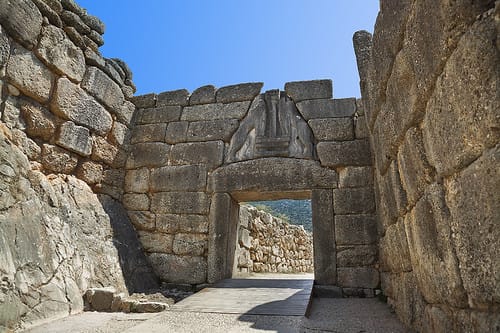
- The archaeological site of Mycenae, where some of the rings were found. Image: Lion Gate at Mycenae, Greece — Discover Peloponnese, CC BY 2.0 (Flickr) (source)